

Sensory processing patterns and their associations with dementia worry among community-dwelling older adults

Background: Changes in sensory input, such as declines in visual and auditory function among community-dwelling older adults, rather than sensory processing characteristics themselves, have been the focus of previous studies. Changes in sensory processing may influence the mental health of older adults.
Objectives: To examine the association between sensory processing patterns and dementia worry among community-dwelling older adults.
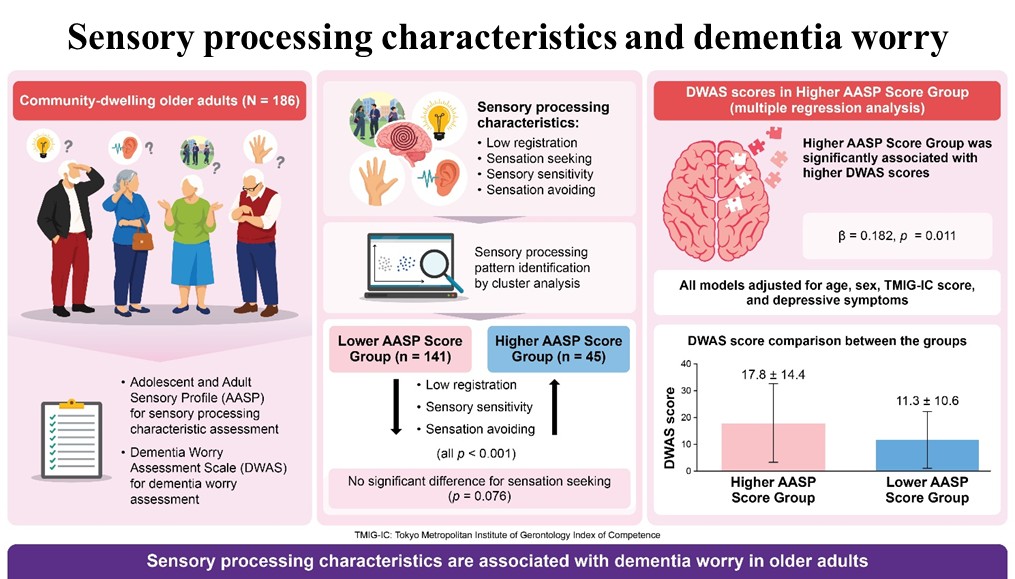
Methods: A self-administered questionnaire survey was conducted among 186 community-dwelling older adults. Sensory processing characteristics were assessed using the Adolescent and Adult Sensory Profile (AASP). Dementia worry was assessed using the Dementia Worry Assessment Scale (DWAS). Sensory processing patterns were extracted using cluster analysis. Multiple regression analysis was conducted using DWAS scores as the dependent variable and sensory processing patterns as independent variables.
Results: Two clusters were identified based on the four AASP quadrants: The “Lower AASP Score Group” and the “Higher AASP Score Group.” In the multiple regression analysis, using the Lower AASP Score Group as the reference, the Higher AASP Score Group was significantly associated with higher DWAS scores (standardized β = 0.182, p = 0.011).
Conclusion: These results suggest that individual differences in sensory processing characteristics may be associated with psychological reactions to dementia in older adulthood. Relatively higher scores for low registration, sensory sensitivity, and sensation avoiding were associated with higher levels of dementia worry.
- United Nations, Department of Economic and Social Affairs, Population Division. World Population Ageing 2020: Highlights. New York, NY: United Nations; 2020.
- World Health Organization. Global Status Report on the Public Health Response to Dementia. Geneva, Switzerland: World Health Organization; 2021.
- Kessler EM, Bowen CE, Baer M, Froelich L, Wahl HW. Dementia worry: a psychological examination of an unexplored phenomenon. Eur J Ageing. 2012;9(4):275-284. doi: 10.1007/s10433-012-0242-8
- Cutler SJ, Brăgaru C. Do worries about cognitive functioning and concerns about developing Alzheimer's disease affect psychological well-being? J Aging Health. 2017;29(8):1271-1287. doi: 10.1177/0898264316674535
- Cui RF, Maxfield M, Fiske A. Dementia-related anxiety and coping styles associated with suicidal ideation. Aging Ment Health. 2020;24(11):1912-1915. doi: 10.1080/13607863.2019.1636205
- Caughie C, Bean P, Tiede P, Cobb J, McFarland C, Hall S. Dementia worry and neuropsychological performance in healthy older adults. Arch Clin Neuropsychol. 2021;36(1):29-36. doi: 10.1093/arclin/acaa057
- Nakayama A, Hoshino J, Usami R, et al. Factors associated with dementia worry among middle-aged or older adults living in a Japanese community: a cross-sectional study. Int J Ment Health Nurs. 2025;34(3):e70077. doi: 10.1111/inm.70077
- Bowen CE, Kessler EM, Segler J. Dementia worry in middle-aged and older adults in Germany: sociodemographic, health-related and psychological correlates. Eur J Ageing. 2019;16(1):39-52. doi: 10.1007/s10433-018-0462-7
- Maxfield M, Pituch KA, Garnaldo A. Profiles in dementia-related anxiety: a latent profile analysis. J Gerontol B Psychol Sci Soc Sci. 2022;77(12):2182-2191. doi: 10.1093/geronb/gbac082
- Werner P, AboJabel H, Maxfield M. Conceptualization, measurement and correlates of dementia worry: a scoping review. Arch Gerontol Geriatr. 2021;92:104246. doi: 10.1016/j.archger.2020.104246
- Baltes PB, Lindenberger U. Emergence of a powerful connection between sensory and cognitive functions across the adult life span: a new window to the study of cognitive aging? Psychol Aging. 1997;12(1):12-21. doi: 10.1037/0882-7974.12.1.12
- Lindenberger U, Baltes PB. Sensory functioning and intelligence in old age: a strong connection. Psychol Aging. 1994;9(3):339-355. doi: 10.1037/0882-7974.9.3.339
- Löffler A, Beier F, Bekrater-Bodmann R, et al. Reduced tactile sensitivity is associated with mild cognitive impairment. EBioMedicine. 2024;99:104896. doi: 10.1016/j.ebiom.2023.104896
- Livingston G, Huntley J, Liu KY, et al. Dementia prevention, intervention, and care: 2024 report of the Lancet standing Commission. Lancet. 2024;404(10452):572-628. doi: 10.1016/S0140-6736(24)01296-0
- Li F, Jin M, Ma T, Cui C, Delano PH. Association between age-related hearing loss and depression: a systematic review and meta-analysis. PLoS One. 2025;20(1):e0298495. doi: 10.1371/journal.pone.0298495
- Huang AR, Suen JJ, Almidani L, Chen Z. Sensory loss and social connection in older adults: a narrative review. Clin Geriatr Med. 2025;41(3):329-341. doi: 10.1016/j.cger.2025.04.005
- Dunn W. The impact of sensory processing abilities on the daily lives of young children and their families: a conceptual model. Infants Young Child. 1997;9(4):23-35. doi: 10.1097/00001163-199704000-00005
- Pohl PS, Dunn W, Brown C. The role of sensory processing in the everyday lives of older adults. OTJR (Thorofare N J). 2003;23(3):99-106. doi: 10.1177/153944920302300303
- Ercan Doğu S, Aydoner Bektaş S. The role of sensory processing patterns on mental health in healthy adults. Br J Occup Ther. 2025;88(9):553-562. doi: 10.1177/03080226251340287
- Engel-Yeger B, Rosenblum S. Executive dysfunctions mediate between altered sensory processing and daily activity performance in older adults. BMC Geriatr. 2021;21(1):132. doi: 10.1186/s12877-021-02032-0
- Lyons-Warren AM, Wangler MF, Wan YW. Cluster analysis of Short Sensory Profile data reveals sensory-based subgroups in autism spectrum disorder. Int J Mol Sci. 2022;23(21):13030. doi: 10.3390/ijms232113030
- Faul F, Erdfelder E, Buchner A, Lang AG. Statistical power analyses using G*Power 3.1: tests for correlation and regression analyses. Behav Res Methods. 2009;41(4):1149-1160. doi: 10.3758/BRM.41.4.1149
- Saeki K, Hoshino J, Usami R, Sakurai M, Furukawa N. Initial development and psychometric evaluation of the Dementia Worry Assessment Scale for Middle-Aged and Older Adults in Japan. Nagoya J Med Sci. 2026;88:375-388. doi: 10.18999/nagjms.88.3.375
- Dunn W. The Adolescent/Adult Sensory Profile: User's Manual. San Antonio, TX: Psychological Corporation; 2002.
- Dunn W. Adolescent/Adult Sensory Profile Japanese Version Manual. Tokyo, Japan: Nihon Bunka Kagakusha; 2015. [In Japanese]
- Yesavage JA, Brink TL, Rose TL, et al. Development and validation of a geriatric depression screening scale: a preliminary report. J Psychiatr Res. 1982;17(1):37-49. doi: 10.1016/0022-3956(82)90033-4
- Sugishita K, Sugishita M, Hemmi I, Asada T, Tanigawa T. A validity and reliability study of the Japanese version of the Geriatric Depression Scale 15 (GDS-15-J). Clin Gerontol. 2017;40(4):233-240. doi: 10.1080/07317115.2016.1199452
- Sheikh JI, Yesavage JA. Geriatric Depression Scale (GDS): recent evidence and development of a shorter version. Clin Gerontol. 1986;5(1-2):165-173. doi: 10.1300/J018v05n01_09
- Folstein MF, Folstein SE, McHugh PR. "Mini-mental state": a practical method for grading the cognitive state of patients for the clinician. J Psychiatr Res. 1975;12(3):189-198. doi: 10.1016/0022-3956(75)90026-6
- Sugishita M, Hemmi I, JADNI. Validity and reliability of Mini Mental State Examination-Japanese (MMSE-J): a preliminary report. Jpn J Cogn Neurosci. 2010;12(3):186-190. doi: 10.11253/ninchishinkeikagaku.12.186
- Koyano W, Shibata H, Nakazato K. Measurement of competence in the elderly living at home: development of an index of competence. Jpn J Public Health. 1987;34:109-115.
- Koyano W, Shibata H, Nakazato K, Haga H, Suyama Y. Measurement of competence: reliability and validity of the TMIG Index of Competence. Arch Gerontol Geriatr. 1991;13(2):103-116. doi: 10.1016/0167-4943(91)90053-S
- van den Boogert F, Klein K, Spaan P, et al. Sensory processing difficulties in psychiatric disorders: a meta-analysis. J Psychiatr Res. 2022;151:173-180. doi: 10.1016/j.jpsychires.2022.04.020
- Hattori R, Irie K, Mori T, Tsurumi K, Murai T, Inadomi H. Sensory processing, autonomic nervous function, and social participation in people with mental illnesses. Hong Kong J Occup Ther. 2023;36(1):39-47. doi: 10.1177/15691861231177355
- Forsberg K, Sutton D, Stjernswärd S, Brown C, Bejerholm U, Argentzell E. Sensory processing patterns and their relationships to coping and occupational engagement in mental health service users. Aust Occup Ther J. 2025;72(1):e13016. doi: 10.1111/1440-1630.13016
- Werner P, Pituch KA, Maxfield M. A latent profile analysis of dementia-related anxiety: a replication and extension study. J Cross Cult Gerontol. 2026;41(1):7. doi: 10.1007/s10823-025-09558-5