

Psychological adjustment and well-being in hidden student mobility: A study of Moldovan students in Romania

Background: Student mobility carries mental health and well-being risks, particularly when transition-related needs are hidden by formal student categories.
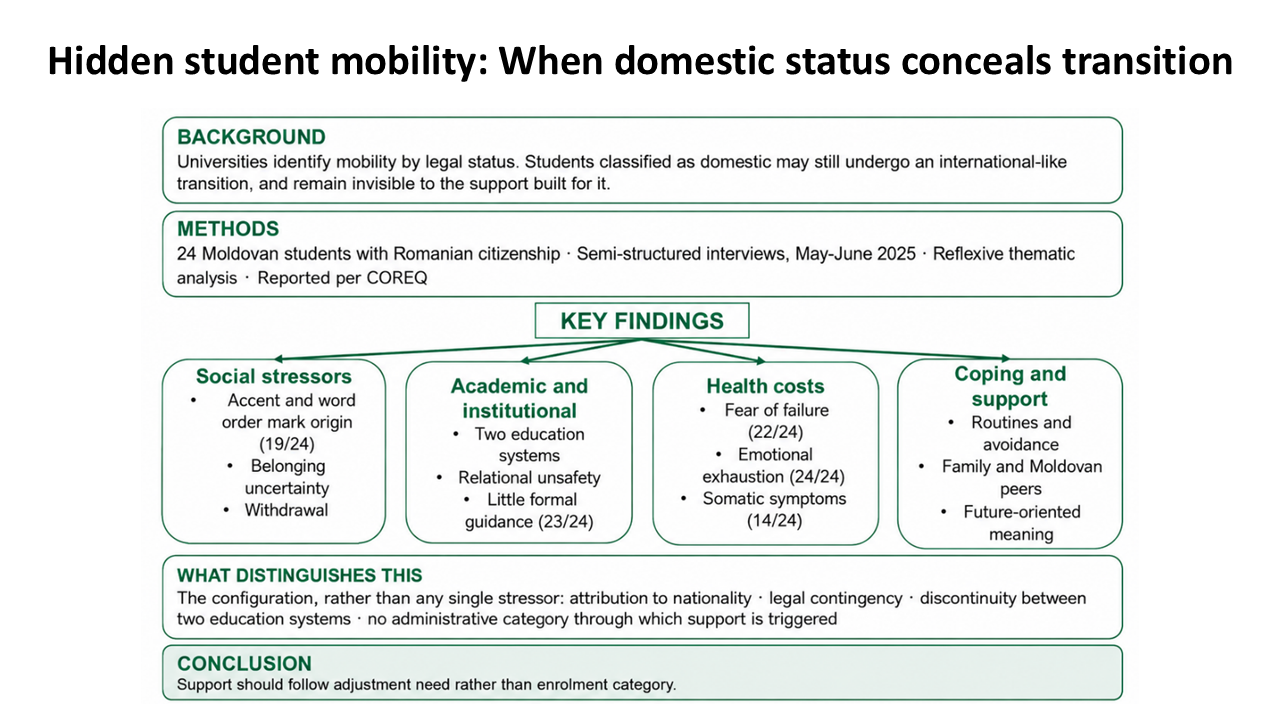
Objective: This short communication examines Moldovan students with Romanian citizenship in Romanian higher education. Legally classified as domestic, they may undergo an international-like adjustment involving linguistic, cultural, academic, and relational transition.
Methods: We analyzed semi-structured interviews with 24 such students using reflexive thematic analysis and interpreted them through an integrated lens of belonging uncertainty, minority stress, and transactional stress-coping models within a biopsychosocial framework. Four themes were generated: social stressors and belonging difficulties, including accent-based othering and withdrawal; academic and institutional stressors, including educational culture mismatch and help-seeking barriers; mental and physical health costs, including fear of failure, emotional exhaustion, and somatic symptoms; and mixed coping and support strategies.
Results: What distinguishes these accounts from generic student adjustment appears to be their configuration: difference attributed to nationality rather than to socioeconomic or regional background, legal contingency, cross-system educational discontinuity, and the absence of any administrative category through which support might be triggered. Because such students are invisible to provision keyed to international status, screening and belonging-based support should be indexed to adjustment need rather than enrollment category, and directed at institutional conduct as well as individual coping.
Conclusion: Hidden student mobility may constitute a distinct adjustment context in which substantial cross-border transition is obscured by domestic administrative status. Recognizing adjustment needs independently of formal enrolment categories may help institutions identify otherwise overlooked students and design more equitable, context-sensitive support.
- Maharaj R, Ndwiga D, Chutiyami M. Mental health and wellbeing of international students in Australia: A systematic review. J Ment Health. 2025;34(4):431-449. doi: 10.1080/09638237.2024.2390393
- van Kessel G, Ryan C, Paras L, Johnson NA, Zariff RZ, Stallman HM. Relationship between university belonging and student outcomes: A systematic review and meta-analysis. Aust Educ Res. 2025;52(3):2511-2534. doi: 10.1007/s13384-025-00822-8
- Walton GM, Murphy MC, Logel C, et al. Where and with whom does a brief social-belonging intervention promote progress in college? Science. 2023;380(6644):499-505. doi: 10.1126/science.ade4420
- Walton GM, Cohen GL. A question of belonging: Race, social fit, and achievement. J Pers Soc Psychol. 2007;92(1):82-96. doi: 10.1037/0022-3514.92.1.82
- Le Forestier JM, Chan EW, Shephard R, Page-Gould E, Chasteen AL. Why is concealment associated with health and wellbeing? An investigation of potential mechanisms. Soc Sci Med. 2024;344:116529. doi: 10.1016/j.socscimed.2023.116529
- Frost DM, Meyer IH. Minority stress theory: Application, critique, and continued relevance. Curr Opin Psychol. 2023;51:101579. doi: 10.1016/j.copsyc.2023.101579
- Yan X. The impact of accent stigma on self-efficacy and acculturation strategy among international students in the United States. Front Psychol. 2024;15:1414282. doi: 10.3389/fpsyg.2024.1414282
- Zhao R, Amanvermez Y, Pei J, et al. Research review: Help-seeking intentions, behaviors, and barriers in college students – a systematic review and meta-analysis. J Child Psychol Psychiatry. 2025;66(10):1593-1605. doi: 10.1111/jcpp.14145
- Schaeffer M, Kas J. The integration paradox: A review and meta-analysis of the complex relationship between integration and reports of discrimination. Int Migr Rev. 2024;58(3):1384-1409. doi: 10.1177/01979183231170809
- Lazarus RS, Folkman S. Stress, Appraisal, and Coping. New York, NY: Springer Publishing Company; 1984.
- Bolton D. A revitalized biopsychosocial model: Core theory, research paradigms, and clinical implications. Psychol Med. 2023;53(16):7504-7511. doi: 10.1017/S0033291723002660
- Braun V, Clarke V. Conceptual and design thinking for thematic analysis. Qual Psychol. 2022;9(1):3-26. doi: 10.1037/qup0000196
- Tong A, Sainsbury P, Craig J. Consolidated criteria for reporting qualitative research (COREQ): A 32-item checklist for interviews and focus groups. Int J Qual Health Care. 2007;19(6):349-357. doi: 10.1093/intqhc/mzm042
- Braun V, Clarke V. To saturate or not to saturate? Questioning data saturation as a useful concept for thematic analysis and sample-size rationales. Qual Res Sport Exerc Health. 2021;13(2):201-216. doi: 10.1080/2159676X.2019.1704846
- Malterud K, Siersma VD, Guassora AD. Sample size in qualitative interview studies: Guided by information power. Qual Health Res. 2016;26(13):1753-1760. doi: 10.1177/1049732315617444
- Kreniske P, Mellins CA, Shea E, et al. Associations between low-household income and first-generation status with college student belonging, mental health, and well-being. Emerg Adulthood. 2023;11(3):710-720. doi: 10.1177/21676968221124649
- Côté-Olijnyk M, Perry JC, Paré ME, Kronick R. The mental health of migrants living in limbo: A mixed-methods systematic review with meta-analysis. Psychiatry Res. 2024;337:115931. doi: 10.1016/j.psychres.2024.115931
- Țițan E, Oțoiu A, Paraschiv D, Manea D. Can earmarked admission places help address the perceived rural disadvantage in higher education access? Evidence from Romania. Oxf Rev Educ. 2024;50(2):167-185. doi: 10.1080/03054985.2022.2136151