

Early evolution of psychological functioning after Takotsubo syndrome: A prospective cohort study

Background: Although ventricular function usually recovers rapidly after Takotsubo syndrome (TTS), little is known about the early evolution of psychological functioning.
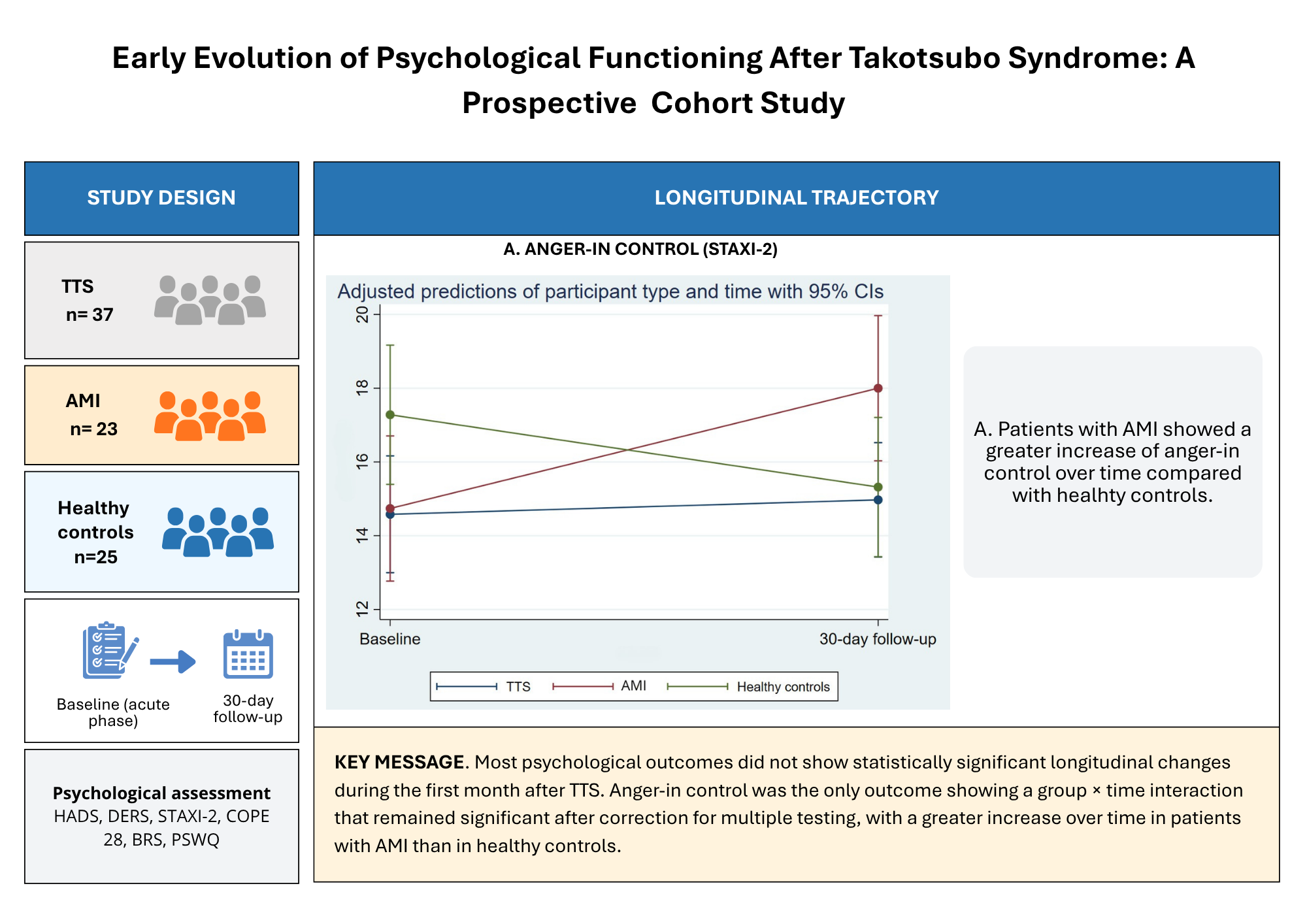
Objectives: In this study, we examined longitudinal changes across multiple psychological domains during the first month in patients with TTS, patients with acute myocardial infarction (AMI), and healthy controls (HC).
Methods: Eighty-five participants (37 TTS, 23 AMI, and 25 HC) completed psychological assessments during the acute phase and 30 days later. The assessment included symptoms of anxiety and depression, anger, coping strategies, emotion regulation, resilience and worry. Longitudinal changes were evaluated using linear mixed-effects models including fixed effects for group, time, and the group × time interaction, with a random intercept for participants.
Results: A significant group × time interaction was observed for anger-in control, with patients with AMI showing a greater increase over time than HC; this interaction remained significant after false discovery rate (FDR) correction for multiple testing. An interaction was also observed for cognitive coping in the primary analysis, but it did not remain significant after FDR correction and was therefore considered exploratory.
Conclusion: Most psychological outcomes did not show statistically significant longitudinal changes during the first month after TTS. These findings highlight the importance of incorporating psychological assessment into routine follow-up after TTS.
- Templin C, Ghadri JR, Diekmann J, et al. Clinical features and outcomes of Takotsubo (stress) cardiomyopathy. N Engl J Med. 2015;373(10):929-938. doi: 10.1056/NEJMoa1406761
- Ghadri JR, Wittstein IS, Prasad A, et al. International expert consensus document on Takotsubo syndrome (part I): clinical characteristics, diagnostic criteria, and pathophysiology. Eur Heart J. 2018;39(22):2032-2046. doi: 10.1093/eurheartj/ehy076
- Jin XX, Ji XR, Yin HP, et al. Identification of Potential Targets of Stress Cardiomyopathy by a Machine Learning Algorithm. Cardiovasc Innov Appl. 2024;9(1):1-13. doi: 10.15212/CVIA.2024.0011
- Salmoirago-Blotcher E, Rosman L, Wittstein IS, et al. Psychiatric history, post-discharge distress, and personality characteristics among incident female cases of Takotsubo cardiomyopathy: a case-control study. Heart Lung. 2016;45(6):503-509. doi: 10.1016/j.hrtlng.2016.07.008. 2016
- Smeijers L, Szabó BM, Kop WJ. Psychological distress and personality factors in Takotsubo cardiomyopathy. Neth Heart J. 2016;24(9):530-537. doi: 10.1007/s12471-016-0861-3
- Galli F, Bursi F, Carugo S. Traumatic events, personality and psychopathology in Takotsubo syndrome: a systematic review. Front Psychol. 2019;10:2742. doi: 10.3389/fpsyg.2019.02742
- Leissner P, Olsson EMG, Rondung E, et al. Mental health status and quality-of-life after an acute myocardial infarction with non-obstructive coronary arteries or Takotsubo syndrome: a systematic review. Eur J Prev Cardiol. 2025. doi: 10.1093/eurjpc/zwaf101
- Kubzansky LD, Huffman JC, Boehm JK, et al. Positive psychological well-being and cardiovascular disease: JACC Health Promotion Series. J Am Coll Cardiol. 2018;72(12):1382-1396. doi: 10.1016/j.jacc.2018.07.042
- DuBois CM, Lopez OV, Beale EE, Healy BC, Boehm JK, Huffman JC. Relationships between positive psychological constructs and health outcomes in patients with cardiovascular disease: a systematic review. Int J Cardiol. 2015;195:265-280. doi: 10.1016/j.ijcard.2015.05.121
- Herranz B, Núñez-Gil IJ, Magan I, et al. Beyond the Stressor: Vulnerability and Difficulties in Stress Regulation in Takotsubo Syndrome: A Retrospective Cross-Sectional Study. Heart Mind. 2026. doi: 10.4103/hm.hm-d-26-00053
- Zigmond AS, Snaith RP. The Hospital Anxiety and Depression Scale. Acta Psychiatr Scand. 1983;67(6):361-370. doi: 10.1111/j.1600-0447.1983.tb09716.x
- Tejero A, Guimerá EM, Farré JM, Peri JM. Uso clínico del HAD (Hospital Anxiety and Depression Scale) en población psiquiátrica: un estudio de su sensibilidad, fiabilidad y validez [Clinical use of the HAD (Hospital Anxiety and Depression Scale) in a psychiatric population: a study of its sensitivity, reliability and validity]. Rev Dep Psiquiatr Fac Med Barc. 1986;13:233-238. [In Spanish]
- Spielberger CD. STAXI-2: State-Trait Anger Expression Inventory-2. Odessa, FL, USA: Psychological Assessment Resources; 1999.
- Spielberger CD, Miguel-Tobal JJ. STAXI-2: Inventario de Expresión de Ira Estado-Rasgo. Madrid, Spain: TEA Ediciones; 2001.
- Carver CS. You want to measure coping but your protocol’s too long: consider the Brief COPE. Int J Behav Med. 1997;4(1):92-100. doi: 10.1207/s15327558ijbm0401_6
- Morán C, Landero R, González MT. COPE-28: un análisis psicométrico de la versión en español del Brief COPE. Univ Psychol. 2010;9(2):543-552. doi: 10.11144/Javeriana.upsy9-2.capv
- Gratz KL, Roemer L. Multidimensional assessment of emotion regulation and dysregulation: development, factor structure, and initial validation of the Difficulties in Emotion Regulation Scale. J Psychopathol Behav Assess. 2004;26(1):41-54. doi: 10.1023/B:JOBA.0000007455.08539.94
- Hervás G, Jódar R. Adaptación al castellano de la Escala de Dificultades en la Regulación Emocional [Spanish adaptation of the Emotional Regulation Difficulties Scale]. Clin Salud. 2008;19(2):139-156. [In Spanish]
- Meyer TJ, Miller ML, Metzger RL, Borkovec TD. Development and validation of the Penn State Worry Questionnaire. Behav Res Ther. 1990;28(6):487-495. doi: 10.1016/0005-7967(90)90135-6
- Sandín B, Chorot P, Valiente RM, Lostao L. Validación española del Cuestionario de Preocupación PSWQ: estructura factorial y propiedades psicométricas [Spanish validation of the PSWQ Worry Questionnaire: factor structure and psychometric properties]. Rev Psicopatol Psicol Clin. 2009;14(2):107-122. [In Spanish]
- Smith BW, Dalen J, Wiggins K, Tooley E, Christopher P, Bernard J. The Brief Resilience Scale: assessing the ability to bounce back. Int J Behav Med. 2008;15(3):194-200. doi: 10.1080/10705500802222972
- Rodríguez-Rey R, Alonso-Tapia J, Hernansaiz-Garrido H. Reliability and validity of the Brief Resilience Scale (BRS) Spanish Version. Psychol Assess. 2016;28(5):e101-e110. doi: 10.1037/pas0000191
- Li P, Dai Q, Cai P, et al. Identifying different phenotypes in Takotsubo cardiomyopathy by latent class analysis. ESC Heart Fail. 2021;8(1):555-565. doi: 10.1002/ehf2.13117
- Yu J, Zhou GX, Guo YZ, et al. Inflammation in Heart Failure: Mechanisms and Therapeutic Strategies. Cardiovasc Innov Appl. 2025;10(1):1-17. doi: 10.15212/CVIA.2024.0050
- Sundelin R, Bergsten C, Tornvall P, Lyngå P. Self-rated stress and experience in patients with Takotsubo syndrome: a mixed methods study. Eur J Cardiovasc Nurs. 2020;19(8):740-747. doi: 10.1177/1474515120919387
- Liu Y, Zheng Y, Lip GYH, et al. Effects of Rivaroxaban on Prognosis in Patients with Acute Myocardial Infarction and Preexisting Atrial Fibrillation. Cardiovasc Innov Appl. 2025;10(1):1-5. doi: 10.15212/CVIA.2025.0028
- Lazarus RS, Folkman S. Stress, Appraisal, and Coping. New York, NY, USA: Springer Publishing Company; 1984
- Fuochi G, Foà C. Quality of life, coping strategies, social support and self-efficacy in women after acute myocardial infarction: a mixed methods approach. Scand J Caring Sci. 2018;32(1):98-107. doi: 10.1111/scs.12435
- Boehm JK. Positive psychological well-being and cardiovascular disease: exploring mechanistic and developmental pathways. Soc Personal Psychol Compass. 2021;15(6):e12599. doi: 10.1111/spc3.12599
- Hahad O, Ghaemi Kerahrodi J, Brähler E, et al. Psychological resilience, cardiovascular disease, and mortality: insights from the German Gutenberg Health Study. J Psychosom Res. 2025;192:112116. doi: 10.1016/j.jpsychores.2025.112116
- Gross JJ. Emotion regulation: current status and future prospects. Psychol Inq. 2015;26(1):1-26. doi: 10.1080/1047840X.2014.940781
- Yalta K, Madias JE, Kounis NG, et al. Takotsubo syndrome: an international expert consensus report on practical challenges and specific conditions. Part 2: specific entities, risk stratification and challenges after recovery. Balkan Med J. 2024;41(6):442-457. doi: 10.4274/balkanmedj.galenos.2024.2024-9-99