

Influence of pranic healing and mindfulness on respiratory function, physical endurance, and well-being: A randomized single-blind study among paramedical students

Background: In pranic healing, a naturopathic biofield (prana) therapy, wellness is achieved by balancing life energy, also known as prana. Studies confirm its effectiveness in lowering rates of depression and anxiety, along with improving sleep quality and functional health.
Objective: To evaluate the effects of mass pranic healing (MPH) on lung function and physical performance among paramedical students and to examine the influence of mindfulness on these outcome measures.
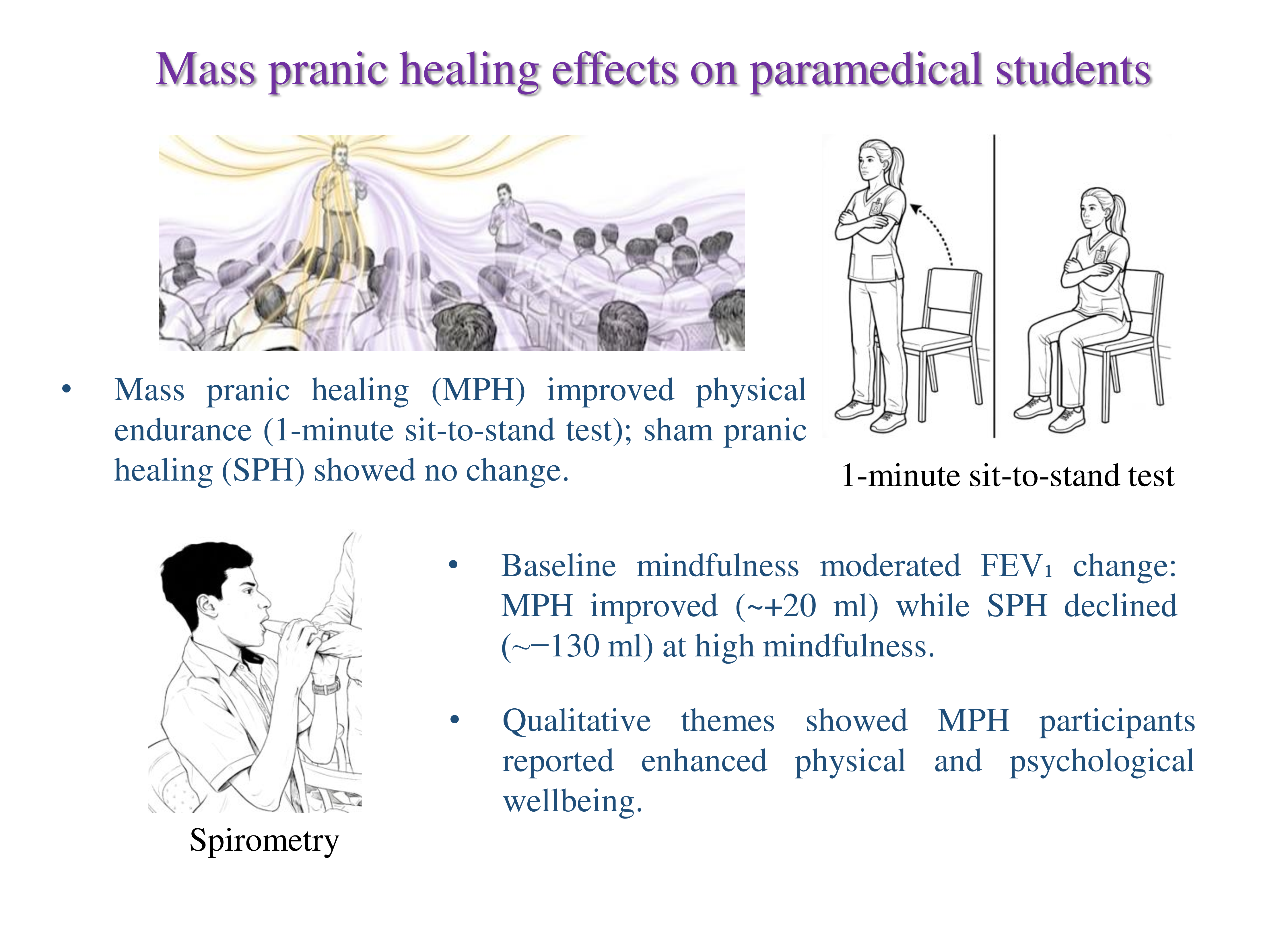
Method: In a four-week randomized controlled trial, 78 paramedical students (mean age 18.86 years) were randomly assigned to the MPH or sham pranic healing (SPH) groups. The study evaluated physical performance using the 1-minute sit-to-stand test, pulmonary function via spirometry, and mindfulness using the Cognitive and Affective Mindfulness Scale, both before and after the intervention. Statistical analyses included a linear mixed model and repeated measures analysis of variance. The experiences of participants were thematically analyzed.
Results: MPH showed a favorable change in physical performance over time (η2 = 0.12), while SPH showed no change. After adjusting for gender and height, baseline mindfulness significantly moderated treatment-related changes in forced expiratory volume in one second. At high baseline mindfulness (mean + 1 standard deviation), SPH declined by approximately 130 mL while MPH improved by approximately 20 mL, producing a 150 mL between-group difference in change. Qualitative feedback showed that MPH participants reported improved physical and psychological health.
Conclusion: MPH showed favorable changes in physical endurance, MPH, mindfulness levels, and lung function. The study found synergistic benefits of pranic healing and mindfulness in promoting respiratory health, physical vitality, and well-being among paramedical students.
- Rubik B, Muehsam D, Hammerschlag R, Jain S. Biofield science and healing: history, terminology, and concepts. Glob Adv Health Med. 2015;4(1_Suppl):8-14. doi: 10.7453/gahmj.2015.038.suppl
- Fakih M, Perbawati C. Relevance of WHO traditional medicine strategy (2014–2023) with traditional health care policy in the perspective of national law and international law. J Asian Legal Stud. 2022;1(1):25-34. doi: 10.53402/ajls.v1i1.117
- Sprengel ML, Teo L, Allen S et al. Biofield Therapies Clinical Research Landscape: A Scoping Review and Interactive Evidence Map. J Integr Complement Med. 2025;31(5):406-430. doi: 10.1089/jicm.2024.0773
- Bodeker G, Ong CK, Grundy C, Burford G, Shien K. WHO global atlas of traditional, complementary and alternative medicine. Vol. 1. World Health Organization, 2005. Accessed December 19, 2025. https://www.who.int/publications/i/item/9241562862
- Jois SN, Prasad KN, D’Souza L, Manasa B. Prana–the vital energy in different cultures: Review on knowledge and practice. J Nat Remedies. 2020;20(3):128-139. doi: 10.18311/jnr/2020/24487
- Nanjundaswamy R, Narendra JB, Vijayakumar V, Jois SN, Nagendra Prasad K. Effectiveness of Pranic Healing as complementary therapy on lower urinary tract symptoms and sleep: Single-blind randomized trial. Complement Ther Med. 2024,84;103067. doi: 10.1016/j.ctim.2024.103067
- Mahesh PA, Srikanth JN, Ananthakrishna MS, et al. Amelioration of quality of life and lung function of chronic obstructive pulmonary disease by pranic healing as adjuvant therapy: A randomised double-blind placebo-controlled pilot study. Australas Med J. 2017;10(18):665-673. doi: 10.21767/AMJ.2017.2953
- Belal M, Vijayakumar V, Prasad K N, Jois SN. Perception of subtle energy “prana”, and its effects during biofield practices: A qualitative meta-synthesis. Glob Adv Integr Med Health. 2023;12:27536130231200477. doi: 10.1177/27536130231200477
- Rajagopal R, Jois SN, Mallikarjuna Majgi S, Anil Kumar MN, Shashidhar HB. Amelioration of mild and moderate depression through Pranic Healing as adjuvant therapy: randomised double-blind controlled trial. Australas Psychiatry. 2018;26(1):82-87. doi: 10.1177/1039856217726449
- Jois SN, D'Souza L, Gayathri R. Effectiveness of Pranic Healing on functional health and well-being of inmates at Mysore Central Prison. Indian J Public Health Res Dev. 2018;9(1):146-151. doi: 10.5958/0976-5506.2018.00027.X
- S. Jois, L. D’Souza, K. Nagendra Prasad, and B. Manasa. Enhancement of quality of life through pranic healing among working women employees, J. Psychol. Educ. Res. 2018;26(1):147-157. Accessed December 19, 2025. https://www.marianjournals.com/files/JPER_articles/JPER_26_1_2018/Jois_et_al_JPER_2018_26_1_147_157.pdf
- Kavuri V, Raghuram N, Malamud A, Selvan SR. Irritable Bowel Syndrome: Yoga as Remedial Therapy. Evid Based Complement Alternat Med. 2015;2015:398156. doi: 10.1155/2015/398156
- Radin D, Stone J, Levine E, et al. Compassionate intention as a therapeutic intervention by partners of cancer patients: effects of distant intention on the patients' autonomic nervous system. Explore (NY). 2008;4(4):235-243. doi: 10.1016/j.explore.2008.04.002
- Trivedi MK, Branton A, Trivedi D, Mondal S, Jana S. Effects of distant biofield energy healing on adults associated with psychological and mental health-related symptoms: a randomized, placebo-controlled, double-blind study. Health Psychol Res. 2024;12(1):122225. doi: 10.52965/001c.122225
- Jois S, Manasa B, D’Souza L, Moulya R, Nagendra Prasad K. Exploratory study on experiences during pranic energy transfer. Psychol Educ. 2019;56(2):27-35. Accessed December 19, 2025. https://psychologyandeducation.net/pae/index.php/pae/Vol_56_No_2_summer_2019
- Pbert L, Madison JM, Druker S et al. Effect of mindfulness training on asthma quality of life and lung function: a randomised controlled trial. Thorax. 2012;67(9):769-776. doi: 10.1136/thoraxjnl-2011-200253
- Nien JT, Wu CH, Yang KT et al. Mindfulness Training Enhances Endurance Performance and Executive Functions in Athletes: An Event-Related Potential Study. Neural Plast. 2020;2020:8213710. doi: 10.1155/2020/8213710
- Liu CH, Lin YC, Huang WC, Sui X, Lavie CJ, Lin GM. Associations of Cardiorespiratory Fitness and Muscular Endurance Fitness with Pulmonary Function in Physically Active Young Adults. Arch Bronconeumol. 2025;61(1):5-12. doi: 10.1016/j.arbres.2024.06.005
- Lazzarelli A, Scafuto F, Crescentini C, et al. Interoceptive ability and emotion regulation in mind-body interventions: an integrative review. Behav Sci (Basel). 2024;14(11):1107. doi: 10.3390/bs14111107
- Raja S, Balasubramanian G, Jamuna Rani R. Prevalence of depression, anxiety and stress among private medical college students in South India: A cross-sectional study. J Educ Health Promot. 2022;11(1):373. doi: 10.4103/jehp.jehp_393_22
- Patil S, Teli A, Nayaka R, Patil P. Assessment of Pulmonary Function in COVID-19 Recovered Health Science Students: A Descriptive Cross-sectional Study. J Clin Diagn Res 2024;18(2). doi: 10.7860/JCDR/2024/64662.19027
- Barooah R, S S, Tasneem Z, Phurailatpam J et al. The Effect of Lockdown on Physiological Parameters of Sleep, Diet, Bowel Movement, Physical Activity, and Menstrual Cycle of Individuals Residing in Northeast India. Cureus. 2025;17(4):e81651. doi: 10.7759/cureus.81651
- Sui CK. Advanced pranic healing: The most advance energy healing system using color pranas. 21st ed. Karnataka, India: Institute for Inner Studies, Publishing Foundation India Private Limited; 2018.
- Kelsey JL, Whittemore AS, Evans AS, Thompson WD. Methods in observational epidemiology. 2nd ed. New York, NY: Oxford University Press; 1996.
- Choa Kok Sui. Pranic Psychotherapy. 2nd ed. Manila, the Philippines: Institute for Inner Studies Publishing Foundation; 2000:248. ISBN: 9719110619.
- Feldman G, Hayes A, Kumar S, Greeson J, Laurenceau JP. Mindfulness and emotion regulation: The development and initial validation of the Cognitive and Affective Mindfulness Scale Revised (CAMS-R). J Psychopathol Behav Assess. 2007;29(3):177-190. doi: 10.1007/s10862-006-9035-8
- Kronberger C, Mousavi RA, Öztürk B et al. Functional capacity testing in patients with pulmonary hypertension (PH) using the one-minute sit-to-stand test (1-min STST). PLoS One. 2023;18(3):e0282697. doi: 10.1371/journal.pone.0282697
- Cohen S. Perceived stress in a probability sample of the United States. In: Shirley Spacapan, Stuart Oskamp, editors. The Social Psychology of Health. Thousand Oaks, CA: Sage Publications; 1988:31-67. Accessed December 19, 2025. https://api.semanticscholar.org/CorpusID:142757482
- Braun V, Clarke V, A critical review of the reporting of reflexive thematic analysis in Health Promotion International. Health Promot Int. 2024;39(3):daae049. doi: 10.1093/heapro/daae049
- Sweta KM, Awasthi HH, Godbole A, Prajapati S. Physio-anatomical resemblance of inferior hypogastric plexus with Muladhara Chakra: A cadaveric study. Ayu. 2017;38(1):7-9. doi: 10.4103/ayu.AYU_140_17
- Nadig A, Jois SN, Prasad KN, Vinu V. Locomotor activities of adult zebrafish (Danio rerio) under the influence of Pranic energy: controlled study. Int J Lakes Rivers. 2020;13(1):43-55. Accessed December 19, 2025. https://www.ripublication.com/ijlr20/ijlrv13n1_05.pdf
- Peck SD. The efficacy of therapeutic touch for improving functional ability in elders with degenerative arthritis. Nurs Sci Q. 1998;11(3):123-32. doi: 10.1177/089431849801100311
- Baldwin AL, Fullmer K, Schwartz GE. Comparison of physical therapy with energy healing for improving range of motion in subjects with restricted shoulder mobility. Evid Based Complement Alternat Med. 2013;2013:329731. doi: 10.1155/2013/329731
- Li M, Zheng S, Lederer AK, Huber R. Efficacy of acupuncture-based treatment in Chronic Obstructive Pulmonary Disease - A systematic review and meta-analysis. Complement Ther Med. 2025;93:103211. doi: 10.1016/j.ctim.2025.103211
- Ponce MC, Sankari A, Sharma S. Pulmonary Function Tests. StatPearls Publishing. Updated August 28, 2023. Accessed July 15, 2026. https://www.ncbi.nlm.nih.gov/books/NBK482339/
- Frima ES, Theodorakopoulos I, Gidaris D, et al. Lung Function Variability in Children and Adolescents With and Without Asthma (LUV Study): Protocol for a Prospective, Nonrandomized, Clinical Trial. JMIR Res Protoc. 2020;9(8):e20350. doi: 10.2196/20350
- Sharma BB, Singh S, Sharma KK, et al. (SWORD study group). Proportionate clinical burden of respiratory diseases in Indian outdoor services and its relationship with seasonal transitions and risk factors: The results of SWORD survey. PLoS One. 2022;17(8):e0268216. doi: 10.1371/journal.pone.0268216
- Born CDC, Bhadra R, D'Souza G, et al. (P4O2 Consortium). Combined Lifestyle Interventions in the Prevention and Management of Asthma and COPD: A Systematic Review. Nutrients. 2024;16(10):1515. doi: 10.3390/nu16101515
- Zhang D, Lee EKP, Mak ECW, Ho CY, Wong SYS. Mindfulness-based interventions: an overall review. Br Med Bull. 2021;138(1):41-57. doi: 10.1093/bmb/ldab005
- Ma X, Yue ZQ, Gong ZQ, et al. The Effect of Diaphragmatic Breathing on Attention, Negative Affect and Stress in Healthy Adults. Front Psychol. 2017;8:874. doi: 10.3389/fpsyg.2017.00874
- Meena BM, Manasa B, Vijayakumar V, Salagame KKK, Jois SN. Nursing Student's Experiences of Meditation on Twin Hearts During Eight Weeks Practice: A Qualitative Content Analysis. SAGE Open Nurs. 2021;7:23779608211052118. doi: 10.1177/23779608211052118
- Vinushree MKS, Vinu V, Jois SN, Venkatakrishna KV. Tridosha Influence on Prana Perception and Well-Being: An Exploratory Study of Pranic Healing Techniques Among Ayurveda Students. Glob Adv Integr Med Health. 2025;14:27536130251366954. doi: 10.1177/27536130251366954
- Matos LC, Machado JP, Monteiro FJ, Greten HJ. Perspectives, Measurability and Effects of Non-Contact Biofield-Based Practices: A Narrative Review of Quantitative Research. Int J Environ Res Public Health. 2021;18(12):6397. doi: 10.3390/ijerph18126397
- Telles S, Singh N, Gupta RK, Balkrishna A. A selective review of dharana and dhyana in healthy participants. J Ayurveda Integr Med. 2016;7(4):255-260. doi: 10.1016/j.jaim.2016.09.004
- Kiken LG, Garland EL, Bluth K, Palsson OS, Gaylord SA. From a state to a trait: Trajectories of state mindfulness in meditation during intervention predict changes in trait mindfulness. Pers Individ Dif. 2015;81:41-46. doi: 10.1016/j.paid.2014.12.044