
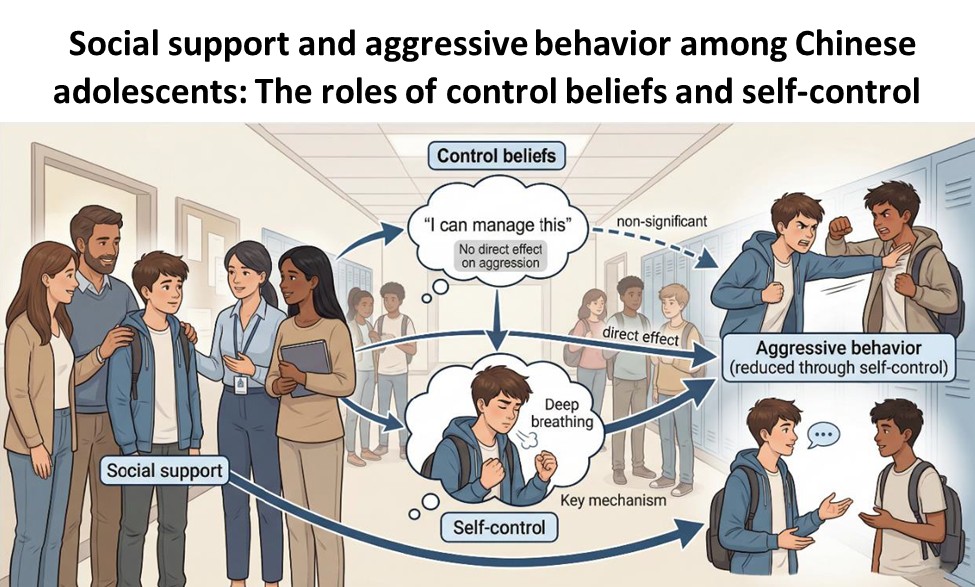
Social support and aggressive behavior among Chinese adolescents: The roles of control beliefs and self-control

Background: Social support has been widely recognized as a psychosocial resource associated with reduced aggressive behavior in adolescence; however, the psychological processes underlying this association remain unclear.
Objective: Guided by the general aggression model, this study examines whether control beliefs and self-control are associated with and may mediate the relationship between perceived social support and aggressive behavior among Chinese adolescents.
Methods: A cross-sectional survey was conducted with 491 secondary school students in China. Participants completed validated self-report measures of perceived social support, control beliefs, self-control, and aggressive behavior. Pearson correlations and serial mediation analyses were performed, controlling for age and gender. Perceived social support was associated negatively with aggressive behavior.
Results: Self-control was found to be a significant mediator of this association. In addition, a sequential association was observed: greater social support was linked to stronger control beliefs, which in turn were associated with greater self-control and less aggressive behavior. The indirect effect of control beliefs alone was not statistically significant.
Conclusion: The findings suggest that social support is associated with lower levels of aggressive behavior, partly through control beliefs processes and a self-control pathway. By clarifying how a modifiable psychosocial resource is linked to adolescent behavioral health through interconnected internal processes, this study provides evidence relevant to promoting adolescent behavioral health and early prevention.relevant to promoting adolescent behavioral health and early prevention.
- Castillo-Eito L, Armitage C, Norman P, Day MR, Doğru OC, Rowe R. How can adolescent aggression be reduced? A multi-level meta-analysis. Clin Psychol Rev. 2020;78:101853. doi: 10.1016/j.cpr.2020.101853
- Wang Y, Liu Y, Wang H, Li R. Social comparison and aggression in mainland Chinese adolescents: Testing the mediating role of self-control. Curr Psychol. 2025;44(3):1631-1642. doi: 10.1007/s12144-025-07288-y
- Chen L, Zhang W, Ji L, Deater-Deckard K. Developmental trajectories of Chinese adolescents’ relational aggression: Associations with changes in social-psychological adjustment. Child Dev. 2019;90(6):2153-2170. doi: 10.1111/cdev.13090
- Hamama L, Ronen-Shenhav A. Self-control, social support, and aggression among adolescents in divorced and two-parent families. Child Youth Serv Rev. 2012;34(5):1042-1049. doi: 10.1016/j.childyouth.2012.02.009
- Anderson CA, Bushman BJ. Human aggression. Annu Rev Psychol. 2002;53(1):27-51. doi: 10.1146/annurev.psych.53.100901.135231
- Agbaria Q, Natur N. The relationship between violence in the family and adolescents aggression: The mediator role of self-control, social support, religiosity, and well-being. Child Youth Serv Rev. 2018;91:447-456. doi: 10.1016/j.childyouth.2018.06.016
- Wright MF, Wachs S. Does social support moderate the relationship between racial discrimination and aggression among Latinx adolescents? A longitudinal study. J Adolesc. 2019;73(1):85-94. doi: 10.1016/j.adolescence.2019.04.001
- Cohen S, Wills TA. Stress, social support, and the buffering hypothesis. Psychol Bull. 1985;98(2):311-357. doi: 10.1037/0033-2909.98.2.310
- Rotter JB. Generalized expectancies for internal versus external control of reinforcement. Psychol Monogr. 1966;80(1):1-28. doi: 10.1037/h0092976
- Botha F, Dahmann SC. Locus of control, self-control, and health outcomes. SSM Popul Health. 2024;25:101566. doi: 10.1016/j.ssmph.2023.101566
- Hobfoll SE. Social and psychological resources and adaptation. Rev Gen Psychol. 2002;6(4):307-324. doi: 10.1037/1089-2680.6.4.307
- Muraven M, Baumeister RF. Self-regulation and depletion of limited resources: Does self-control resemble a muscle? Psychol Bull. 2000;126(2):247-259. doi: 10.1037/0033-2909.126.2.247
- Mohan L, Roos LG, Bui TQ, Sichko S, Slavich GM. Social support and cognitive reappraisal in adolescent females: The moderating role of lifetime stressor exposure. Int J Clin Health Psychol. 2024;24(4):100525. doi: 10.1016/j.ijchp.2024.100525
- Baumeister RF, Vohs KD, Tice DM. The strength model of self-control. Curr Dir Psychol Sci. 2007;16(6):351-355. doi: 10.1111/j.1467-8721.2007.00534.x
- Wu Y, Chen X, Qu J. Explaining Chinese delinquency: Self-control, morality, and criminogenic exposure. Crim Justice Behav. 2022;49(4):571-592. doi: 10.1177/00938548211034840
- Mancinelli E, Liberska HD, Li JB, et al. A cross-cultural study on attachment and adjustment difficulties in adolescence: The mediating role of self-control in Italy, Spain, China, and Poland. Int J Environ Res Public Health. 2021;18(16):8827. doi: 10.3390/ijerph18168827
- Rothenberg WA, Lansford JE, Bacchini D, et al. Cross-cultural effects of parent warmth and control on aggression and rule-breaking from ages 8 to 13. Aggress Behav. 2020;46(4):327-340. doi: 10.1002/ab.21892
- Voulgaridou I, Kokkinos CM. Relational aggression in adolescents across different cultural contexts: A systematic review of the literature. Adolesc Res Rev. 2023;8(4):457-480. doi: 10.1007/s40894-023-00207-x
- Yang F, Jin Z, He J, et al. Aggressive behaviors and associated factors in chinese left-behind adolescents: A cross-sectional study. BMC Pediatr. 2022;22(1). doi: 10.1186/s12887-022-03736-x
- Xin Z, Chi L, Geng L, Zhao X, Wang J. Er Tong Ji Qing Shao Nian She Hui Zhi Chi Liang Biao De Zhong Wen Ban Xiu Ding Ji Chu Bu Ying Yong [Revision and application of the Social Support Rating Scale for adolescents]. Chin Ment Health J. 2017;(6):379-385. [In Chinese] doi: 10.16128/j.cnki.1005-3611.2017.04.018
- Xin Z, Ma J, Geng L. Qing Shao Nian Wu Wang Gan Yu Sheng Huo Shi Jian, Kong Zhi Xin Nian He She Hui Zhi Chi De Guan Xi [Relationships between adolescents’ hopelessness and life events, control beliefs and social supports]. Psychol Dev Educ. 2006;22(3):41-46. [In Chinese] doi: 10.16187/j.cnki.issn1001-4918.2006.03.008
- Li X, Li Z, Zhang L. Qing Shao Nian She Hui Zhi Chi Yu Gong Ji De Guan Xi: Zi Zun, Zi Wo Kong Zhi De Lian Shi Zhong Jie Zuo Yong [Relationship between adolescents’ social support and aggression: The chain mediating roles of self-esteem and self-control]. Psychol Dev Educ. 2017;33(2):240-248. [In Chinese] doi: 10.16187/j.cnki.issn1001-4918.2017.02.13
- Buss AH, Perry M. The aggression questionnaire. J Pers Soc Psychol. 1992;63(3):452-459. doi: 10.1037/0022-3514.63.3.452
- Podsakoff PM, MacKenzie SB, Lee JY, Podsakoff NP. Common method biases in behavioral research: A critical review of the literature and recommended remedies. J Appl Psychol. 2003;88(5):879-903. doi: 10.1037/0021-9010.88.5.879
- Liu H, Dou K, Yu C, Nie Y, Zheng X. The relationship between peer attachment and aggressive behavior among Chinese adolescents: The mediating effect of regulatory emotional self-efficacy. Int J Environ Res Public Health. 2021;18(13):7123. doi: 10.3390/ijerph18137123
- Tan S, Yang R, Abdukerima G, et al. Unraveling the role of social support in eating behavior among children and adolescents in Shanghai, China: Exploring the mediating role of self-efficacy and the moderating influence of BMI and weight concern. Front Nutr. 2024;11:1411097. doi: 10.3389/fnut.2024.1411097
- Ge W, Wang H, Chen J, Yang X, Wang Y. How general control beliefs relate to depressive symptoms in adolescents: The role of emotion controllability beliefs and emotion regulation. Curr Psychol. 2024;43(35):28531-28543. doi: 10.1007/s12144-024-06489-1
- Han JY, Lee H, Ohtsubo Y, Masuda T. Culture and stress coping: cultural variations in the endorsement of primary and secondary control coping for daily stress across european canadians, east Asian Canadians, and the Japanese. Jpn Psychol Res. 2022;64(2):141-155. doi: 10.1111/jpr.12406
- Reife I, Duffy S, Grant KE. The impact of social support on adolescent coping in the context of urban poverty. Cultur Divers Ethnic Minor Psychol. 2020;26(2):200-214. doi: 10.1037/cdp0000296
- Li JB, Vazsonyi AT, Dou K. Is individualism-collectivism associated with self-control? Evidence from Chinese and U.S. samples. PLoS One. 2018;13(12):e0208541. doi: 10.1371/journal.pone.0208541