

Machine learning-driven prediction of decisional uncertainty among medical students post-Kahramanmaras earthquake

Background: Predicting psychiatric outcomes in individuals indirectly affected by natural disasters remains a significant challenge. While direct victims receive immediate attention, indirect victims—including family and friends of those affected—can also experience considerable psychological distress.
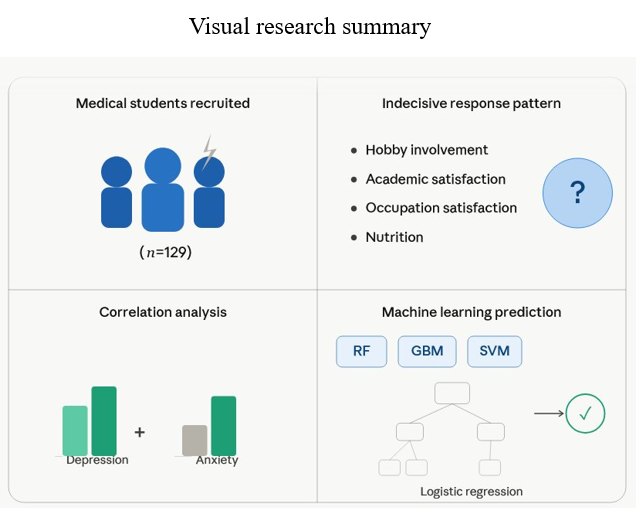
Objective: This study explores the tendency to report decisional uncertainty (selecting “not sure” responses) regarding emotional and academic states, which may be associated with depressive symptoms. We operationalized this tendency using a pragmatic proxy: the sum of “not sure” responses across four self-report domains, rather than a validated decisional uncertainty scale.
Methods: Medical students (n = 129), both indirectly affected and unaffected by the Kahramanmaras earthquake through family exposure, were recruited. The proxy measure for decisional uncertainty was calculated from responses concerning hobbies, nutrition, occupational satisfaction, and academic success. Associations with depression, anxiety, and earthquake exposure were analyzed using correlation analyses. Exploratory machine learning (ML) models—including random forest (RF), gradient boosting machines, and support vector machines—were employed to explore the feasibility of classifying this decisional uncertainty proxy.
Results: A weak positive correlation was found between the decisional uncertainty proxy and depression scores (r = 0.247, p = 0.005). However, a multivariable model identified academic and nutritional status as stronger independent predictors of the proxy than depression or anxiety scores. In exploratory ML analysis, models such as RF demonstrated the feasibility of classifying decisional uncertainty, achieving above-chance accuracy.
Conclusion: Preliminary findings suggest a weak association between a simple proxy for decisional uncertainty and depressive symptoms. Exploratory ML approaches show initial promise in identifying this proxy status. These results highlight a novel methodological pathway; however, they are preliminary and underscore the necessity for future validation and calibration against a dedicated, clinically validated decisional uncertainty instrument before any substantive clinical or predictive claims can be made.
- Dedeoglu IO, Yetkin M, Tunc G, Ozbulut OE. Evaluating earthquake-induced damage in Dogansehir, Malatya after 2023 Kahramanmaras Earthquake sequence: Geotechnical and structural perspectives. J Build Eng. 2025;104:112266. doi: 10.1016/j.jobe.2025.112266
- Yılmaz S, Karakayali O, Yilmaz S, et al. Emergency medicine association of Turkey disaster committee summary of field observations of February 6th Kahramanmaras earthquakes. Prehosp Disaster Med. 2023;38(3):415-418. doi: 10.1017/S1049023X23000523
- Afyonoğlu MF, Pak Güre MD. Unveiling collective grief: A qualitative study of X posts reflecting on the Kahramanmaras earthquake anniversary in Türkiye. Death Stud. 2026;50(1):1-13. doi: 10.1080/07481187.2024.2404927
- Kaya M, Bayram SS. Determining the impact of earthquakes on university students’ hope and anxiety levels. Int J Disaster Risk Reduct. 2024;110:104637. doi: 10.1016/j.ijdrr.2024.104637
- Shultz JM, Besser A, Kelly F, et al. Psychological Consequences of Indirect Exposure to Disaster Due to the Haiti Earthquake. Prehosp Disaster Med. 2012;27(4):359- 368. doi: 10.1017/S1049023X12001008
- Kocoglu E, Demir FB, Öteles ÜU, Özeren E. Post-Earthquake Trauma Levels of University Students Evaluation: Example of 6 February Kahramanmaras Earthquake. High Educ Stud. 2023;13(2):121-127. doi: 10.5539/hes.v13n2p121
- Gökkaya E, Kuday AD, Çelebi I. Mental health impact of the 2023 Kahramanmaras earthquakes: Prevalence of PTSD, depression, anxiety, and stress among survivors. J Health Psychol. 2025;30(12):3284-3296. doi: 10.1177/13591053251324277
- Kiymis I, Fakioglu M. The psychological consequences of 6 February 2023 Kahramanmaras earthquakes. Nat Hazards. 2025;121(3):2919-2940. doi: 10.1007/s11069-024-06902-9
- Kaplan V, Alkasaby M, Düken ME, Kaçkin Ö, Riad A. The impact of earthquakes on women: assessing women’s mental health in aftermath of the Kahramanmaras-centred earthquake in Türkiye. J Public Health. 2024;46(3):e510-e519. doi: 10.1093/pubmed/fdae059
- Yilmaz E, Erdem M. Post-traumatic stress disorder in earthquake survivors living in temporary shelter areas in Hatay central districts: a cross-sectional study. BMC Psychiatry. 2025;25(1):461. doi: 10.1186/s12888-025-06919-9
- Campbell DG, Felker BL, Liu C-F, et al. Prevalence of depression–PTSD comorbidity: Implications for clinical practice guidelines and primary care-based interventions. J Gen Intern Med. 2007;22(6):711-718. doi: 10.1007/s11606-006-0101-4
- Leykin Y, Roberts CS, DeRubeis RJ. Decision-Making and Depressive Symptomatology. Cognit Ther Res. 2011;35(4):333-341. doi: 10.1007/s10608-010-9308-0
- Di Schiena R, Luminet O, Chang B, Philippot P. Why are Depressive Individuals Indecisive? Different Modes of Rumination Account for Indecision in Non-clinical Depression. Cognit Ther Res. 2013;37(4):713-724. doi: 10.1007/s10608-012-9517-9
- Amidfar M, Ko YH, Kim YK. Neuromodulation and Cognitive Control of Emotion. In: Advances in Experimental Medicine and Biology. New York, NY: Springer; 2019:545- 564. doi: 10.1007/978-981-32-9721-0_27
- Battaglia S, Andero R, Thayer JF. Translational cross-species evidence of heart-related dynamics in threat learning. Neurosci Biobehav Rev. 2025;176:106273. doi: 10.1016/j.neubiorev.2025.106273
- Hao J, Ho TK. Machine learning made easy: a review of scikit-learn package in python programming language. J Educ Behav Stat. 2019;44(3):348-361. doi: 10.3102/1076998619832248
- Breiman L. Random forests. Mach Learn. 2001;45(1):5-32.
- Uludag K. Hyperparameters and Tuning Methods for Random Forest Using Python Sklearn Package Relevant to Psychology Studies. In: Clinical Practice and Unmet Challenges in AI-Enhanced Healthcare Systems. Hershey, PA: IGI Global; 2024:207-222. doi: 10.4018/979-8-3693-2703-6.ch011
- Suthaharan S. Support Vector Machine. In: Suthaharan S, ed. Machine Learning Models and Algorithms for Big Data Classification: Thinking with Examples for Effective Learning. New York, NY: Springer US; 2016:207-235. doi: 10.1007/978-1-4899-7641-3_9
- Walsh J, Heazlewood I, Climstein M. Application of gradient boosted trees to gender prediction based on motivations of masters athletes. Model Assist Stat Appl. 2018;13(3):235-252. doi: 10.3233/MAS-180438
- Kapci EG, Uslu R, Turkcapar H, Karaoglan A. Beck Depression Inventory II: evaluation of the psychometric properties and cut‐off points in a Turkish adult population. Depress Anxiety. 2008;25(10):E104-E110. doi: 10.1002/da.20371
- Ulusoy M, Sahin NH, Erkmen H. Turkish version of the Beck Anxiety Inventory: psychometric properties. J Cogn Psychother. 1998;12(2):163-172.
- Germeijs V, Verschueren K. Indecisiveness and Big Five personality factors: Relationship and specificity. Pers Individ Dif. 2011;50(7):1023-1028. doi: 10.1016/j.paid.2011.01.017
- Bacanli F. Personality characteristics as predictors of personal indecisiveness. J Career Dev. 2006;32(4):320-332. doi: 10.1177/0894845305282941
- Lawlor VM, Webb CA, Wiecki TV, et al. Dissecting the impact of depression on decision-making. Psychol Med. 2020;50(10):1613-1622. doi: 10.1017/S0033291719001570
- Bullock-Yowell E, McConnell AE, Schedin EA. Decided and undecided students: Career self-efficacy, negative thinking, and decision-making difficulties. Nacada J. 2014;34(1):22- 34. doi: 10.12930/nacada-13-016
- Sert H, Gulbahar Eren M, Koc F, Yurumez Y. Depression, anxiety, stress, and job performance among Turkish nurses in the early post-earthquake period. Int Nurs Rev. 2025;72(1):e12920. doi: 10.1111/inr.12920
- Şam M, Sever G, Yildiz Yüksel H, Aliyev R. Earthquake effects on youth: understanding psychological challenges and support needs. BMC Psychol. 2025;13(1):72. doi: 10.1186/s40359-025-02373-0
- Türkkan T, Hatipoğlu E. Factors affecting the mental health of youth after the Great Kahramanmaras earthquake disaster. J Soc Serv Res. 2025;51(2):335-347. doi: 10.1080/01488376.2024.2352158
- Öztekin GG, Örki H. Effects of depression, anxiety, and stress on disaster preparedness: Evidence from the February 6 Türkiye earthquakes. Afet Risk Derg. 2023;6(4):1332-1347. doi: 10.35341/afet.1326948
- Kung Y-W, Chen S-H. Perception of Earthquake Risk in Taiwan: Effects of Gender and Past Earthquake Experience. Risk Anal. 2012;32(9):1535-1546. doi: 10.1111/j.1539-6924.2011.01760.x