

Depressive symptom status and heart-disease mortality among adults in the United States: NHANES 2015–2018 with contextual Global Burden of Disease analyses

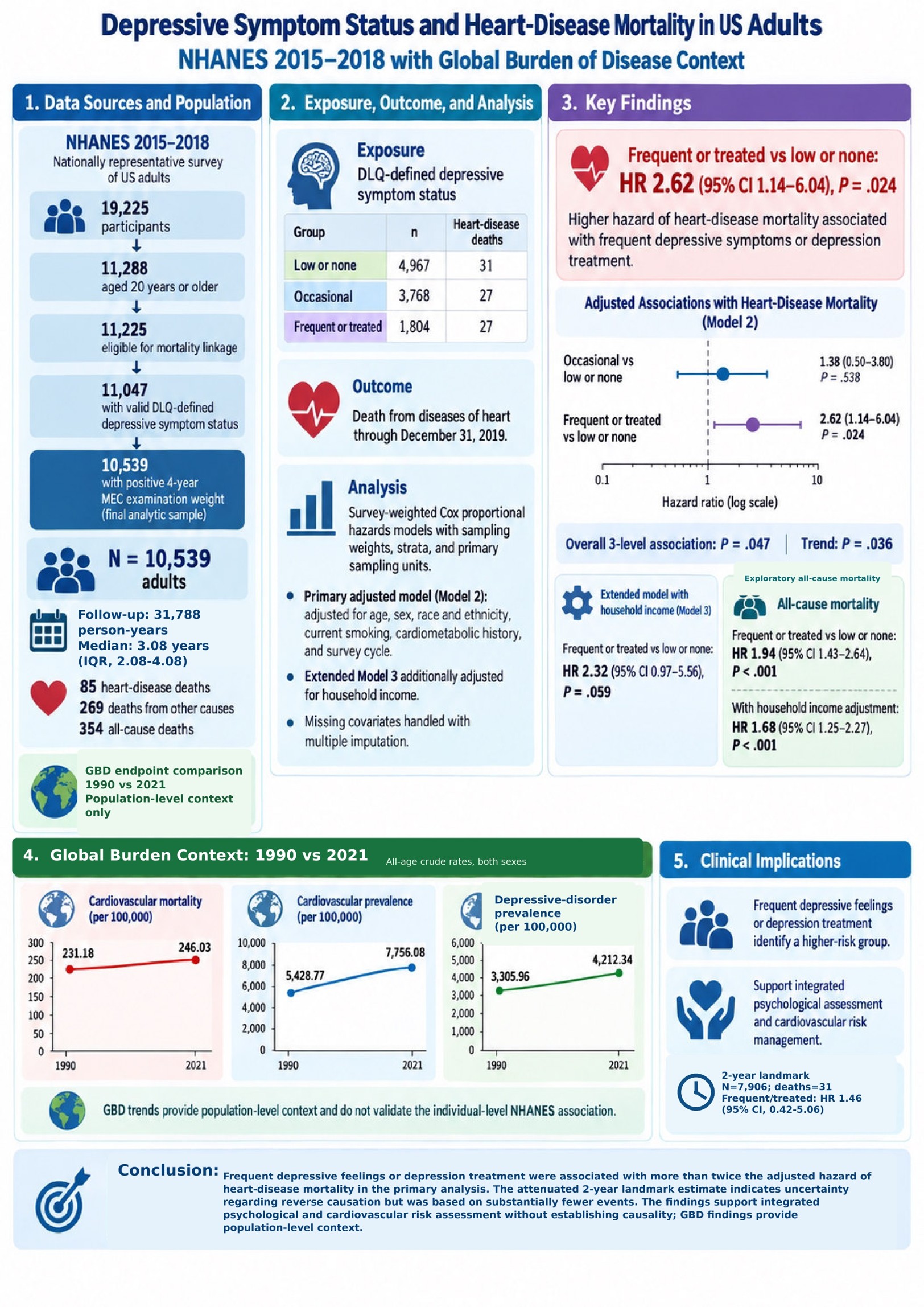
Background: Depressive symptoms may indicate cardiovascular risk, but survey design and sparse deaths complicate mortality analyses.
Objectives: To examine the association between three-level, Disability Questionnaire-defined depressive symptom status and heart-disease mortality, with Global Burden of Disease estimates providing context.
Methods: Adults aged 20 years or older in the National Health and Nutrition Examination Survey (NHANES), 2015–2018 were linked to 2019 mortality records with follow-up through December 31, 2019. Survey-weighted Cox models adjusted for demographics, smoking, cardiometabolic history, and survey cycle. Missing covariates were multiply imputed. Additional analyses addressed household income, medication for depression, alternative exposure definitions, short follow-up, prior cardiovascular disease, and competing risks.
Results: Among 10,539 adults, 85 heart-disease deaths and 354 all-cause deaths occurred over 31,788 person-years. Compared with low/no symptoms, frequent symptoms or depression treatment were associated with higher heart-disease mortality (hazard ratio [HR], 2.62; 95% confidence interval [CI], 1.14–6.04; p = 0.024). The overall association (p = 0.047) and trend (p = 0.036) were significant; occasional symptoms were not associated with mortality. Income adjustment attenuated the HR to 2.32 (95% CI, 0.97–5.56; p = 0.059). All-cause mortality was elevated (HR, 1.94; 95% CI, 1.43–2.64; p < 0.001). Depression treatment alone yielded an HR of 1.84 (95% CI, 0.85–4.02). In the 2-year landmark analysis (31 deaths), the HR was 1.46 (95% CI, 0.42–5.06). Global estimates showed higher reported depression and cardiovascular disease prevalence in 2021 versus 1990.
Conclusions: Frequent symptoms or treatment identified elevated heart-disease mortality risk, although imprecision and landmark attenuation raise concern about reverse causation. The findings support depressive symptom status as a cardiovascular risk marker rather than establishing a causal effect.
- Vaduganathan M, Mensah GA, Turco JV, Fuster V, Roth GA. The global burden of cardiovascular diseases and risk: a compass for future health. J Am Coll Cardiol. 2022;80(25):2361-2371. doi: 10.1016/j.jacc.2022.11.005
- Lindstrom M, DeCleene N, Dorsey H, et al. Global burden of cardiovascular diseases and risks collaboration, 1990-2021. J Am Coll Cardiol. 2022;80(25):2372-2425. doi: 10.1016/j.jacc.2022.11.001
- Cui L, Li S, Wang S, et al. Major depressive disorder: hypothesis, mechanism, prevention and treatment. Signal Transduct Target Ther. 2024;9(1):30. doi: 10.1038/s41392-024-01738-y
- Carney RM, Freedland KE, Rich MW. Treating depression to improve survival in coronary heart disease: what have we learned? J Am Coll Cardiol. 2024;84(5):482-489. doi: 10.1016/j.jacc.2024.05.038
- Meng R, Yu C, Liu N, et al. Association of depression with all-cause and cardiovascular disease mortality among adults in China. JAMA Netw Open. 2020;3(2):e1921043. doi: 10.1001/jamanetworkopen.2019.21043
- Rajan S, McKee M, Rangarajan S, et al. Association of symptoms of depression with cardiovascular disease and mortality in low-, middle-, and high-income countries. JAMA Psychiatry. 2020;77(10):1052-1063. doi: 10.1001/jamapsychiatry.2020.1351
- Borgi M, Biondi-Zoccai G, Frati G, et al. Cardiovascular disease and mental health: a dangerous duo? Eur J Prev Cardiol. 2023;30(15):1686-1688. doi: 10.1093/eurjpc/zwad199
- Gaffey AE, Rollman BL, Burg MM. Strengthening the pillars of cardiovascular health: psychological health is a crucial component. Circulation. 2024;149(9):641-643. doi: 10.1161/CIRCULATIONAHA.123.066132
- Levine GN, Cohen BE, Commodore-Mensah Y, et al. Psychological health, well-being, and the mind-heart-body connection: a scientific statement from the American Heart Association. Circulation. 2021;143(10):e763-e783. doi: 10.1161/CIR.0000000000000947
- Santosa A, Rosengren A, Ramasundarahettige C, et al. Psychosocial risk factors and cardiovascular disease and death in a population-based cohort from 21 low-, middle-, and high-income countries. JAMA Netw Open. 2021;4(12):e2138920. doi: 10.1001/jamanetworkopen.2021.38920
- Pitharouli MC, Hagenaars SP, Glanville KP, et al. Elevated C-reactive protein in patients with depression, independent of genetic, health, and psychosocial factors: results from the UK Biobank. Am J Psychiatry. 2021;178(6):522-529. doi: 10.1176/appi.ajp.2020.20060947
- Chen R, Fu X, Liu M, et al. Online depression communities as a complementary approach to improving the attitudes of patients with depression toward medication adherence: cross-sectional survey study. J Med Internet Res. 2024;26:e56166. doi: 10.2196/56166
- Rush AJ, Thase ME. Improving depression outcome by patient-centered medical management. Am J Psychiatry. 2018;175(12):1187-1198. doi: 10.1176/appi.ajp.2018.18040398
- Gast A, Mathes T. Medication adherence influencing factors-an (updated) overview of systematic reviews. Syst Rev. 2019;8(1):112. doi: 10.1186/s13643-019-1014-8
- von Elm E, Altman DG, Egger M, et al. The Strengthening the Reporting of Observational Studies in Epidemiology (STROBE) statement: guidelines for reporting observational studies. J Clin Epidemiol. 2008;61(4):344-349. doi: 10.1016/j.jclinepi.2007.11.008
- Johnson CL, Paulose-Ram R, Ogden CL, et al. National health and nutrition examination survey: analytic guidelines, 1999-2010. Vital Health Stat 2. 2013;(161):1-24. https://stacks.cdc.gov/view/cdc/255108
- Shen R, Zhao N, Wang J, et al. Association between level of depression and coronary heart disease, stroke risk and all-cause and cardiovascular mortality: data from the 2005-2018 National Health and Nutrition Examination Survey. Front Cardiovasc Med. 2022;9:954563. doi: 10.3389/fcvm.2022.954563
- Liu T, Wang L, Zhu Z, et al. Association of both depressive symptoms scores and specific depressive symptoms with all-cause and cardiovascular disease mortality. Ann Gen Psychiatry. 2024;23(1):25. doi: 10.1186/s12991-024-00509-x
- Lee SY, Lee JP, Lee J, Park JY, Kim EY. Association between depressive symptoms and the risk of all-cause and cardiovascular mortality among US adults. Prog Neuropsychopharmacol Biol Psychiatry. 2023;125:110755. doi: 10.1016/j.pnpbp.2023.110755
- Xu L, Zhai X, Shi D, et al. Depression and coronary heart disease: mechanisms, interventions, and treatments. Front Psychiatry. 2024;15:1328048. doi: 10.3389/fpsyt.2024.1328048
- Wang T, Li Y, Zheng X. Association of socioeconomic status with cardiovascular disease and cardiovascular risk factors: a systematic review and meta-analysis. J Public Health (Berl). 2024;32(3):385-399. doi: 10.1007/s10389-023-01825-4
- Chen D, Ejlskov L, Laustsen LM, et al. The role of socioeconomic position in the association between mental disorders and mortality: a systematic review and meta-analysis. JAMA Psychiatry. 2024;81(2):125-134. doi: 10.1001/jamapsychiatry.2023.4316
- GBD 2019 Mental Disorders Collaborators. Global, regional, and national burden of 12 mental disorders in 204 countries and territories, 1990-2019: a systematic analysis for the Global Burden of Disease Study 2019. Lancet Psychiatry. 2022;9(2):137-150. doi: 10.1016/S2215-0366(21)00395-3
- Ski CF, Taylor RS, McGuigan K, et al. Psychological interventions for depression and anxiety in patients with coronary heart disease, heart failure or atrial fibrillation. Cochrane Database Syst Rev. 2024;4(4):CD013508. doi: 10.1002/14651858.CD013508.pub3