

Acute physiological and mood changes associated with a single 60-minute Nirvana Fitness session in young women

Background: Evidence regarding physiological and psychological changes associated with Nirvana Fitness (NF) in women remains limited.
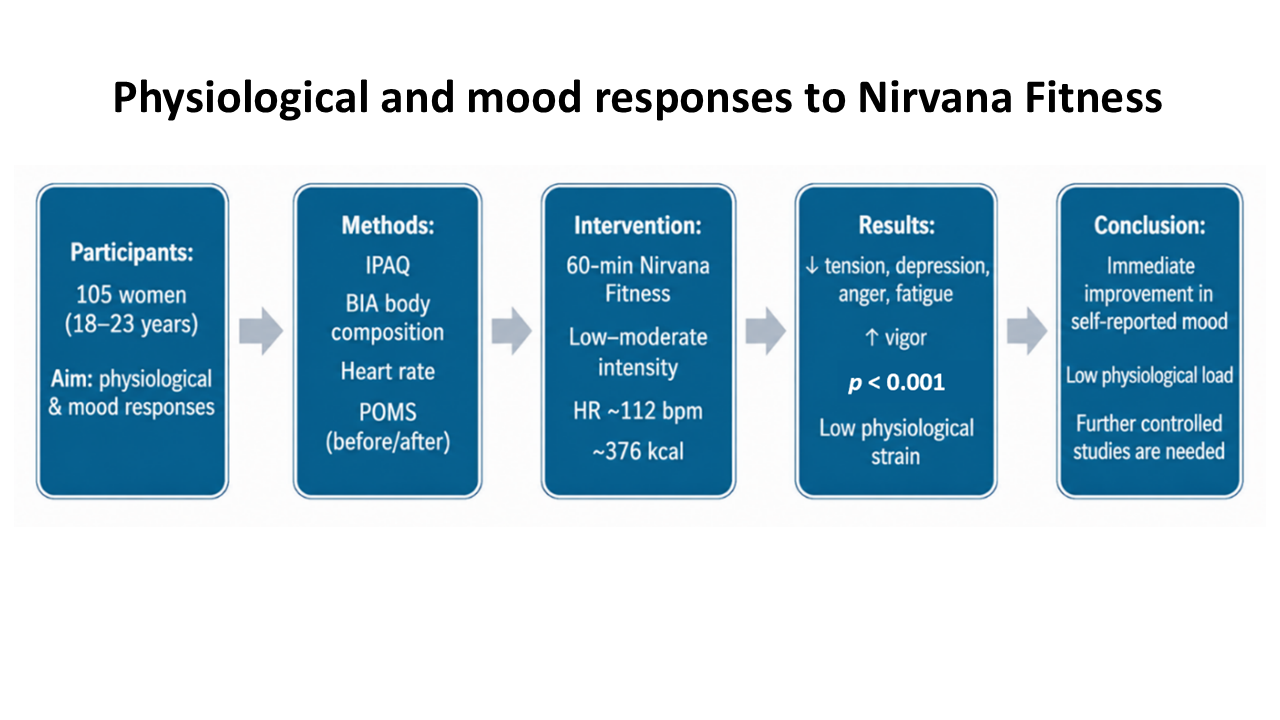
Objective: This study examined physiological responses and mood changes before and after a single 60-minute NF session in young women.
Methods: The study included 105 female university students aged 18.1–23.0 years (mean age, 20.07 ± 1.14 years). We assessed physical activity levels using the Polish short version of the International Physical Activity Questionnaire. We measured anthropometric characteristics and body composition using bioelectrical impedance analysis before the training session, and we evaluated mood states before and after the session using the Profile of Mood States questionnaire.
Results: Participants demonstrated moderate physical activity levels and normal body mass index values, although body fat percentage was close to the upper reference range. The session was characterized by low-to-moderate physiological intensity (mean heart rate, 112.4 bpm; estimated energy expenditure, approximately 376 kcal), with low estimated oxygen uptake and respiratory responses. Significant pre–post changes in mood states were observed, including reductions in emotional tension, depression, anger, confusion, and fatigue, and an increase in vigor (all p < 0.001).
Conclusion: Immediate changes in self-reported mood states were observed after a single NF session; however, the single-arm pre–post design does not allow these changes to be attributed specifically to NF. The findings should therefore be considered preliminary, and controlled studies are needed to determine whether NF contributes to these changes in mood states in young women.
- Jankauskiene R, Balciuniene V, Rutkauskaite R, Pajaujiene S, Baceviciene M. The effects of Nirvana fitness and functional training on the body appreciation of young women: a non-randomized controlled trial. Front Psychol. 2024;15:1412259. doi: 10.3389/fpsyg.2024.1412259
- Brown RP, Gerbarg PL. Sudarshan Kriya yogic breathing in the treatment of stress, anxiety, and depression. Part I: neurophysiologic model. J Altern Complement Med. 2005;11(1):189-201. doi: 10.1089/acm.2005.11.189
- Jerath R, Edry JW, Barnes VA, Jerath V. Physiology of long pranayamic breathing and autonomic nervous system shift. Med Hypotheses. 2006;67(3):566-571. doi: 10.1016/j.mehy.2006.02.042
- Zaccaro A, Piarulli A, Laurino M, Garbella E, Menicucci D, Neri B, et al. How breath-control can change your life: a systematic review on psycho-physiological correlates of slow breathing. Front Hum Neurosci. 2018;12:353. doi: 10.3389/fnhum.2018.00353
- Jayawardena R, Ranasinghe P, Ranawaka H, Gamage N, Dissanayake D, Misra A. Therapeutic benefits of pranayama: systematic review. Int J Yoga. 2020;13(2):99-110. doi: 10.4103/ijoy.IJOY_37_19
- Kavitha N, Pal P, Pal GK, Bharadwaj B, Nanda N. Effects of slow breathing exercises on cardiac autonomic functions in anxiety disorder: a randomised control trial. Ann Neurosci. 2024;33(3):283-292. doi: 10.1177/09727531241266094
- Lehrer PM, Gevirtz R. Heart rate variability biofeedback: how and why does it work? Front Psychol. 2014;5:756. doi: 10.3389/fpsyg.2014.00756
- Kesar, Nathani N. Scientific effect of pranayama (hatha yogic breath regulation techniques) on physiological and psychological variables: a systematic review. Yoga Mimamsa. 2025;57(1):48-56. doi: 10.4103/ym.ym_11_25
- Jankauskiene R, Balciuniene V, Rutkauskaite R, Pajaujiene S, Baceviciene M. Evaluating the impact of the Nirvana fitness and functional training programs on young women's state body appreciation and its correlates. Healthcare (Basel). 2024;12(16):1632. doi: 10.3390/healthcare12161632
- Courtney R. The functions of breathing and its dysfunctions and their relationship to breathing therapy. Int J Osteopath Med. 2009;12(3):78-85. doi: 10.1016/j.ijosm.2009.04.002
- Kolar P, Sulc J, Kyncl M, Sanda J, Cakrt O, Andel R, et al. Postural function of the diaphragm in persons with and without chronic low back pain. J Orthop Sports Phys Ther. 2012;42(4):352-362. doi: 10.2519/jospt.2012.3830
- Balban MY, Neri E, Kogon MM, et al. Brief structured respiration practices enhance mood and reduce physiological arousal. Cell Rep Med. 2023;4(1):100895. doi: 10.1016/j.xcrm.2022.100895
- Siebieszuk A, Płoński AF, Baranowski M. Breathwork for chronic stress and mental health: does choosing a specific technique matter? Med Sci (Basel). 2025;13(3):127. doi: 10.3390/medsci13030127
- Solianik R, Ivanova J. Effects of the Nirvana fitness exercise programme on perceived stress and cognition. Reabilit Moksl. 2022;2(27):1-7. doi: 10.33607/rmske.v2i27.1257
- Russo M, De Luca R, Naro A, et al. Does body shadow improve the efficacy of virtual reality-based training with BTS NIRVANA?: a pilot study. Medicine (Baltimore). 2017;96(38):e8096. doi: 10.1097/MD.0000000000008096
- De Luca R, Russo M, Naro A, Tomasello P, Leonardi S, Santamaria F, et al. Effects of virtual reality-based training with BTS-Nirvana on functional recovery in stroke patients: preliminary considerations. Int J Neurosci. 2018;128(9):791-796. doi: 10.1080/00207454.2017.1403915
- Balciuniene V, Jankauskiene R, Baceviciene M. Effect of an education and mindfulness-based physical activity intervention for the promotion of positive body image in Lithuanian female students. Eat Weight Disord. 2022;27(2):563-577. doi: 10.1007/s40519-021-01195-4
- Jankauskiene R, Balciuniene V, Rutkauskaite R, Baceviciene M. Sustainability of positive body image changes one year after exercise interventions in young women. Behav Sci (Basel). 2026;16(1):83. doi: 10.3390/bs16010083
- Yeung RR. The acute effects of exercise on mood state. J Psychosom Res. 1996;40(2):123-141. doi: 10.1016/0022-3999(95)00554-4
- Weinstein AA, van Aert RCM, Donovan K, Muskens L, Kop WJ. Affective responses to acute exercise: a meta-analysis of the potential beneficial effects of a single bout of exercise on general mood, anxiety, and depressive symptoms. Psychosom Med. 2024;86(6):486-497. doi: 10.1097/PSY.0000000000001321
- Fleming KM, Campbell M, Herring MP. Acute effects of Pilates on mood states among young adult males. Complement Ther Med. 2020;49:102313. doi: 10.1016/j.ctim.2020.102313
- Mandlik GV, Siopis G, Nguyen B, Ding D, Edwards KM. Effect of a single session of yoga and meditation on stress reactivity: a systematic review. Stress Health. 2024;40(3):e3324. doi: 10.1002/smi.3324
- Fincham GW, Strauss C, Montero-Marin J, Cavanagh K. Effect of breathwork on stress and mental health: a meta-analysis of randomised-controlled trials. Sci Rep. 2023;13(1):432. doi: 10.1038/s41598-022-27247-y
- Shao R, Man ISC, Lee TMC. The effect of slow-paced breathing on cardiovascular and emotion functions: a meta-analysis and systematic review. Mindfulness. 2024;15(1):1-18. doi: 10.1007/s12671-023-02294-2
- McNulty KL, Elliott-Sale KJ, Dolan E, et al. Effects of menstrual cycle phase on exercise performance: systematic review and meta-analysis. Sports Med. 2020;50(10):1813-1827. doi: 10.1007/s40279-020-01319-3
- Elorduy-Terrado A, Torres-Luque G, Radesca K, Muñoz-Andradas G, Saenz-Bravo M, Domínguez-Balmaseda D. Impact of hormonal fluctuations during the menstrual cycle on performance of female athletes: systematic review. Muscles. 2025;4(2):15. doi: 10.3390/muscles4020015
- Biernat E, Stupnicki R, Gajewski AK. International Physical Activity Questionnaire (IPAQ) - Polish version. Phys Educ Sport. 2007;51(1):47-54.
- Podstawski R, Żurawik MA, Clark CCT, Ihasz F, Żurek P. The intensities of various forms of physical activity in physical education programs offered by universities for female students. Motriz Rev Educ Fis. 2020;26(4). doi: 10.1590/s1980-65742020000400089
- Dudek B, Koniarek J. Adaptacja testu McNair DM, Lorr M, Droppleman LF "Profile of Mood States" (POMS) [Adaptation of the test "Profile of Mood States" (POMS) by McNair DM, Lorr M, Droppleman LF]. Przegląd Psychologiczny. 1987;3:753-762. [In Polish]
- Lee J, Park BJ, Tsunetsugu Y, Ohira T, Kagawa T, Miyazaki Y. Effect of forest bathing on physiological and psychological responses in young Japanese male subjects. Public Health. 2011;125(2):93-100. doi: 10.1016/j.puhe.2010.09.005
- Bielinis E, Łukowski A, Omelan A, Boiko S, Takayama N, Grebner DL. The effect of recreation in a snow-covered forest environment on the psychological wellbeing of young adults: randomized controlled study. Forests. 2019;10(10):827. doi: 10.3390/f10100827
- McNair DM, Lorr M, Droppleman LF. Manual for the Profile of Mood States. San Diego, CA: Educational and Industrial Testing Service; 1971.
- Terry PC, Lane AM, Fogarty GJ. Construct validity of the Profile of Mood States-Adolescents for use with adults. Psychol Sport Exerc. 2003;4(2):125-139. doi: 10.1016/S1469-0292(01)00035-8
- Gibson SJ. Measurement of mood states in older adults. J Gerontol B Psychol Sci Soc Sci. 1997;52B(4):P167-P174. doi: 10.1093/geronb/52B.4.P167
- Czartoryski P, Garcia J, Manimaleth R, et al. Body composition assessment: a comparison of DXA, InBody 270, and Omron. J Exerc Nutr. 2020;3(1):1-6. Accessed March 3, 2020. https://journalofexerciseandnutrition.com/index.php/JEN/article/view/57
- Podstawski R, Borysławski K, Clark CCT, Choszcz D, Finn KJ, Gronek P. Correlations between repeated use of dry sauna for 4 x 10 minutes, physiological parameters, anthropometric features, and body composition in young sedentary and overweight men: health implications. Biomed Res Int. 2019;2019:1-13. doi: 10.1155/2019/7535140
- Grosicki GJ, Durk RP, Bagley JR. Rapid gut microbiome changes in a world-class ultramarathon runner. Physiol Rep. 2019;7(24):e14313. doi: 10.14814/phy2.14313
- Montgomery PG, Green DJ, Etxebarria N, Pyne DB, Saunders PU, Minahan CL. Validation of heart rate monitor-based predictions of oxygen uptake and energy expenditure. J Strength Cond Res. 2009;23(5):1489-1495. doi: 10.1519/JSC.0b013e3181a39277
- Podstawski R, Borysławski K, Józefacka NM, Snarska J, Hinca B, Biernat E, et al. Influence of extreme thermal stress on physiological and psychological characteristics of young women. Front Public Health. 2024;11:1303804. doi: 10.3389/fpubh.2023.1303804
- Podstawski R, Borysławski K, Pomianowski A, Soós I, Boraczyński M, Gronek P. Physiological response to thermal stress in obese vs non-obese inactive men. Biology (Basel). 2022;11(3):471. doi: 10.3390/biology11030471
- Omelan A, Wisniewska J, Podstawski R. Body composition and psychophysical well-being of women practicing yoga. Balt J Health Phys Act. 2022;14(3):e04. doi: 10.29359/BJHPA.14.3.04
- World Health Organization. Waist Circumference and Waist-Hip Ratio: Report of a WHO Expert Consultation, Geneva, 8-11 December 2008. Geneva, Switzerland: World Health Organization; 2011.
- Jayedi A, Soltani S, Zargar MS, Khan TA, Shab-Bidar S. Central fatness and risk of all cause mortality: systematic review and dose-response meta-analysis of 72 prospective cohort studies. BMJ. 2020;370:m3324. doi: 10.1136/bmj.m3324
- Singh P, Sharma H. Mental and physical health of yoga practitioners and non-practitioners. Int J Multidiscip Approach Stud. 2017;4(4):14-24.
- Vogler S, Salyer RE, Giacobbi PR. Yoga and mental well-being: a qualitative exploration of lived experiences. Int J Yoga. 2023;16(3):192-201. doi: 10.4103/ijoy.ijoy_191_23
- Fleming KM, Herring MP. Effects of Pilates on mental health outcomes: meta-analysis of controlled trials. Complement Ther Med. 2018;37:80-95. doi: 10.1016/j.ctim.2018.02.003