

Psychological and occupational factors associated with nomophobia among healthcare professionals: A systematic review and meta-analysis

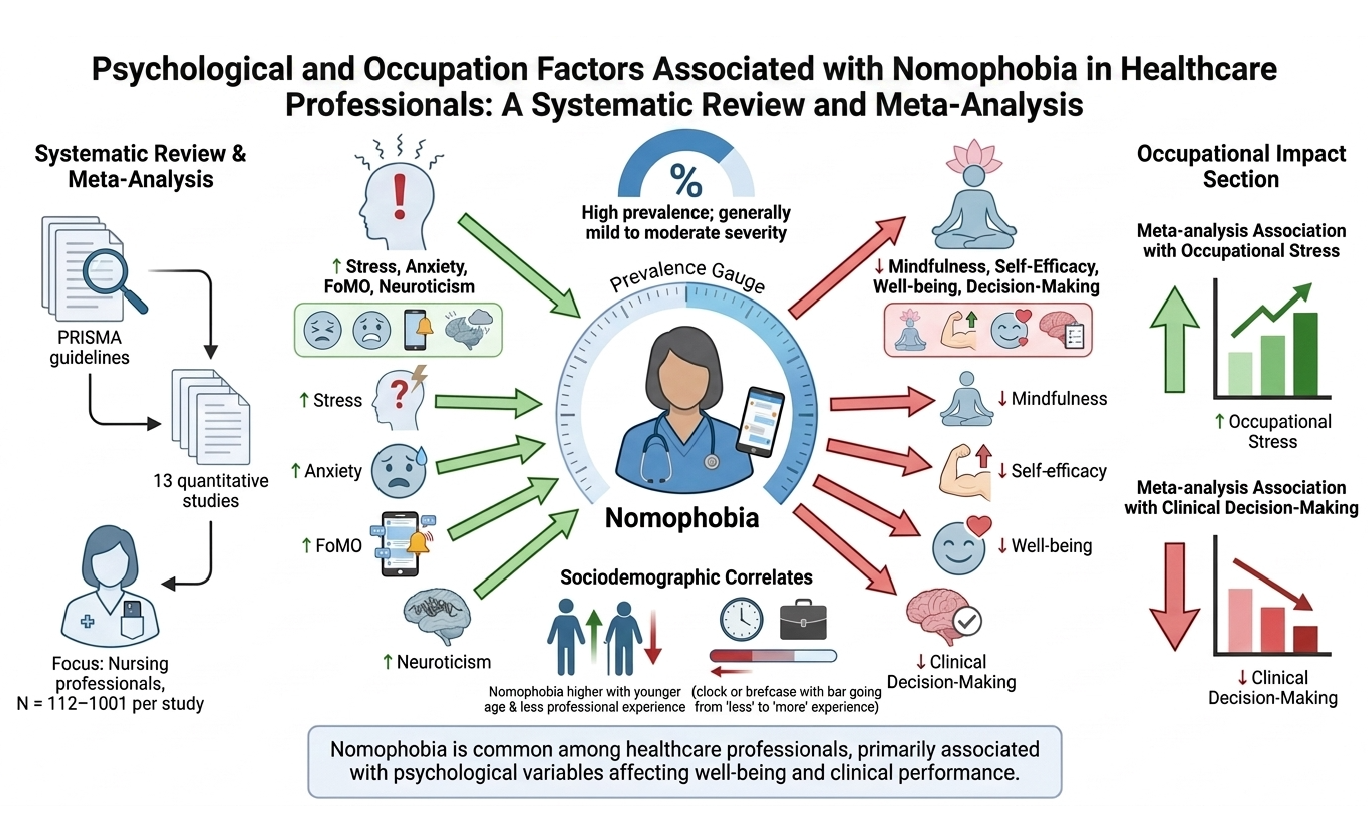
Nomophobia is an emerging phenomenon with potential effects on mental health and professional performance. In the healthcare field, smartphone use is frequent for both personal and work-related reasons; however, the evidence regarding its prevalence and associated factors is heterogeneous, making it difficult to draw integrated conclusions. This study explores the prevalence of nomophobia and analyzes its relationship with sociodemographic, psychological, and occupational variables among healthcare professionals through a systematic review and meta-analysis. A systematic review and meta-analysis were conducted in accordance with the Preferred Reporting Items for Systematic Reviews and Meta-Analyses guidelines, with the protocol registered with PROSPERO (CRD420261329317). A search was conducted in Web of Science, Scopus, and ProQuest without time restrictions for quantitative observational studies involving healthcare professionals that assessed nomophobia using validated instruments. Data were extracted on sociodemographic characteristics, prevalence, severity, and psychological and occupational associations. A correlational meta-analysis was performed using a random-effects model. Eighteen published studies were included, with sample sizes ranging from 112 to 1,083 participants, mainly nursing professionals. The prevalence of nomophobia was high, generally at mild-to-moderate levels. It was consistently associated with younger age and less professional experience, and showed positive associations with stress, anxiety, fear of missing out, and neuroticism, and negative associations with mindfulness, self-efficacy, well-being, and clinical decision-making. Evidence regarding occupational variables was limited. The meta-analyses indicated a significant association with occupational stress, a negative association with decision-making, and a positive association with well-being. Nomophobia is common among healthcare professionals and is mainly associated with psychological variables relevant to well-being and clinical performance.
- Xiao B, Parent N, Hein-Salvi C, Shapka J. Shyness and problematic internet use among adolescents and young adults: a systematic review and meta-analysis. Cogent Ment Health. 2023;2(1). doi: 10.1080/28324765.2023.2278879
- Dwyer RJ, Zhuo AX, Dunn EW. Why do people turn to smartphones during social interactions? J Exp Soc Psychol. 2023;109:104506. doi: 10.1016/j.jesp.2023.104506
- Ruiz-Ruano A, López-Salmerón M, López Puga J. Experiential avoidance and excessive smartphone use: a Bayesian approach. Adicciones. 2020;32(2):116-127. doi: 10.20882/adicciones.1151
- Mudgal S, Sharma S, Gaur R, Sharma M, Patidar V. Prevalence and severity of nomophobia among nurses: a systematic review and meta-analysis. Invest Educ Enferm. 2024;42(3):e05. doi: 10.17533/udea.iee.v42n3e05
- Al-Mamun F, Mamun M, Kaggwa M, et al. The prevalence of nomophobia: A systematic review and meta-analysis. Psychiatry Res. 2025;349:116521. doi: 10.1016/j.psychres.2025.116521
- Gutiérrez-Puertas V, Gutiérrez-Puertas L, Aguilera- Manrique G, Rodríguez-García M, Márquez-Hernández V. Nursing students’ perceptions of smartphone use in the clinical care and safety of hospitalised patients. Int J Environ Res Public Health. 2021;18(3):1307. doi: 10.3390/ijerph18031307
- Santl L, Brajković L, Kopilaš V. Relationship between nomophobia, various emotional difficulties, and distress factors among students. Eur J Investig Health Psychol Educ. 2022;12(7):716-730. doi: 10.3390/ejihpe12070053
- Lu X, An X, Chen S. Trends and influencing factors in problematic smartphone use prevalence (2012-2022): a systematic review and meta-analysis. Cyberpsychol Behav Soc Netw. 2024;27(9):616-634. doi: 10.1089/cyber.2023.0548
- Meng S, Cheng J, Li Y, et al. Global prevalence of digital addiction in general population: a ystematic review and meta-analysis. Clin Psychol Rev. 2022;92:102128. doi: 10.1016/j.cpr.2022.102128
- Sayed I, Ahmed M, Hussein H, Abdelmoaty Ahmed S, Sayed A. Nomophobia among health care providers: a prevalence and association study. Bangladesh J Med Sci. 2026;25(1):163- 168. doi: 10.3329/bjms.v25i1.86415
- Gonçalves S, Dias P, Correia A. Nomophobia and lifestyle: Smartphone use and its relationship to psychopathologies. Comput Hum Behav Rep. 2020;2:100025. doi: 10.1016/j.chbr.2020.100025
- Jahrami H, Trabelsi K, Boukhris O, et al. The prevalence of mild, moderate, and severe nomophobia symptoms: A systematic review, meta-analysis, and meta-regression. Behav Sci. 2022;13(1):35. doi: 10.3390/bs13010035
- Olivencia-Carrión MA, Ferri-García R, Rueda MDM, Jiménez-Torres M, López-Torrecillas F. Temperament and characteristics related to nomophobia. Psychiatry Res. 2018;266:5-10. doi: 10.1016/j.psychres.2018.04.056
- Erdurmazlı E, Erdem H, Türen U, Gökmen Y, Can Yalçın R. Nomophobia in today’s overlapping work and family domains: The influences on organizational identification. J Gen Manag. 2024;49(4):289-302. doi: 10.1177/03063070221117928
- Juwita S, Karmiyati D. Nomophobia in adolescents: a comprehensive literature review based on Albert Bandura’s social cognitive theory. In: Proceedings of the International Conference on Psychology and Education (ICPE). Surabaya, Indonesia: UNESA: 2024;3(1). Accessed March 6, 2026. https://proceeding.unesa.ac.id/index.php/icpe/article/ view/3652
- Alhaj H, Muthana A, Abdalla A, Marouf M, Awad N. How are FOMO and nomophobia linked to symptoms of depression, anxiety and stress among university students? BJPsych Open. 2024;10(S1):S16-S17. doi: 10.1192/bjo.2024.104
- Mejía-Trejo J. NOMOFOMO in the health of the smartphone user for the new normal: a contribution to the Social Media Health Interaction Theory. Sci Et Prax. 2022;1(2):51-82. doi: 10.55965/setp.1.02.a3
- Ceobanu C, Marian A, Apostolache R. Glimpse on 21st century new phobias: a predictive model of nomophobia. Front Public Health. 2023;11:1252099. doi: 10.3389/fpubh.2023.1252099
- Daraj L, AlGhareeb M, Almutawa Y, Trabelsi K, Jahrami H. Systematic review and meta-analysis of the correlation coefficients between nomophobia and anxiety, smartphone addiction, and insomnia symptoms. Healthc. 2023;11(14):2066. doi: 10.3390/healthcare11142066
- Amin M, Alhadi H, Mohamed A, et al. Impact of smartphone addiction on health status, mental well-being, and sleep quality among medical students in Sudan. BMC Psychiatry. 2024;24(1):965. doi: 10.1186/s12888-024-06377-9
- Lin Y, Zhou X. Unravelling the dynamics between smartphone use and psychological well-being: a two-wave panel study. Behav Inf Technol. 2025;44(16):3935-3961. doi: 10.1080/0144929X.2025.2455399
- Ndayambaje E, Okereke P. The psychopathology of problematic smartphone use (PSU): a narrative review of burden, mediating factors, and prevention. Health Sci Rep. 2025;8(5):e70843. doi: 10.1002/hsr2.70843
- World Health Organization: WHO. Mental health. Who.int. 2025. Accessed May 26, 2026. https://www.who.int/news-room/fact-sheets/detail/mental-health-strengthening-our-response
- American Psychiatric Association. Diagnostic and Statistical Manual of Mental Disorders: DSM-5TM, 5th Ed. American: Psychiatric Publishing, Inc.; 2013. doi: 10.1176/appi.books.9780890425596
- American Psychiatric Association. Diagnostic and Statistical Manual of Mental Disorders (DSM-5-TR). American: Psychiatric Publishing; 2022. doi: 10.1176/appi.books.9780890425787
- Yildiz S, Kutlu D, Yildiz R. El efecto de la nomofobia en el ciberloafing entre los empleados de las empresas turísticas [The effect of Nomophobia on Cyberloafing among employees in tourism enterprises]. Vivat Academia. 2023;156:173-198. [In Spanish] doi: 10.15178/va.2023.e1465.
- Hessari H, Daneshmandi F, Busch P, Smith S. Workplace nomophobia: a systematic literature review. Curr Psychol. 2024;43(31):25934-25954. doi: 10.1007/s12144-024-06222-y
- John B, McCreary C, Roberts A. Smartphone technology for clinical communication in the COVID-19 era: a commentary on the concerning trends in data compliance. Front Digit Health. 2022;4:816604. doi: 10.3389/fdgth.2022.816604
- Moher D, Shamseer L, Clarke M, et al. Preferred reporting items for systematic review and meta-analysis protocols (PRISMA-P) 2015 statement. Syst Rev. 2015;4(1):1. doi: 10.1186/2046-4053-4-1
- Dinçer Y, Çelik İnce S. Determining the effects of nomophobia on nurses and midwives in a maternity and child health hospital: a cross-sectional study. Int Nurs Rev. 2025;72(2):e13021. doi: 10.1111/inr.13021
- Öner U, Aslan S, Ekingen E. The Mediating Role of the Care Factor in the Effect of Nomophobia on Nurses’ Job Satisfaction. Makara J Health Res. 2026;30(1):41-47. doi: 10.7454/msk.v30i1.1927
- Bülbüloğlu S, Özdemir A, Kapıkıran G, Sarıtaş S. The effect of nomophobic behavior of nurses working at surgical clinics on time management and psychological well-being. J Subst Use. 2020;25(3):318-323. doi: 10.1080/14659891.2019.1692926
- Lupo R, Zacchino S, Caldararo C, et al. The use of electronic devices and relative levels of nomophobia within a group of Italian nurses: an observational study. Epidemiol Biostat Public Health. 2022;17(1):e13272. doi: 10.2427/13272
- Kapikiran G, Karakas N, Kartal M. The effects of the nomophobic behaviors of emergency room nurses on their clinical decision-making perceptions: a cross-sectional study. Comput Hum Behav. 2023;138:107478. doi10.1016/j. chb.2022.107478
- Sharma K, Parihar A, Sharma S, Nebhinani N, Mudakavi I. Nomophobia and its impact on mindfulness and self-efficacy among nurses: An analytical cross-sectional study in the institution of national importance, Western India. J Educ Health Promot. 2024;13(1):184. doi: 10.4103/jehp.jehp_1057_23
- Çam F, Koçkesen B, Gesme HG, Pelen Ş, Taş K, Aştı TA. The Relationship Between Nomophobia and Caring Behaviors Among Nurses: Cross Sectional and Descriptive Study. HBD. 2025;8(2):209-220. doi: 10.54189/hbd.1580271
- Zunira A, Arshad H, Aslam A, Farooq A. Impact of nomophobic behavior on nurses’ care behaviors working in intensive care unit in tertiary care hospitals Lahore, Pakistan. Pak J Intensive Care Med. 2025;5(1):83. doi: 10.54112/pjicm.v5i01.83
- Uguz G, Bacaksiz F. Relationships between personality traits and nomophobia: research on nurses working in public hospitals. Perspect Psychiatr Care. 2022;58(2):673-681. doi: 10.1111/ppc.12834
- Vitale E. NO MObile PHOone phoBIA among young Italian nurses during the COVID-19 pandemic: a cohort observational study based on gender, age, work experience and shiftwork. J Sex Gend Specif Med. 2022;8(2):97-104. doi: 10.1723/3853.38365
- Vitale E, Mea R, Benedetto A, et al. Anxiety, Depression, Body Mass Index, Physical Activity in Nomophobic Italian Nurses: A Chronic Latent Inflammation? Endocr Metab Immune Disord Drug Targets. 2023;23(11):1421-1429. doi: 10.2174/1871530323666230310152747
- Yang Z, Zhu B, Ke J, Yu L, Zhao H. The effect of nomophobic behaviors among nurses on their clinical decision-making perceptions. Nurse Educ Pract. 2024;77:103978. doi: 10.1016/j.nepr.2024.103978
- Hoşgör H, Coşkun F, Çalişkan F, Gündüz Hoşgör D. Relationship between nomophobia, fear of missing out, and perceived work overload in nurses in Turkey. Perspect Psychiatr Care. 2021;57(3):1026-1033. doi: 10.1111/ppc.12653
- Al A, Başpınar M, Basat O. The relationship of job satisfaction with nomophobia and social media addiction in health care professionals. Bagcilar Med Bull.2022;7(4):311-318. doi: 10.4274/BMB.galenos.2022.2022-06-052
- Alasimi A, Aldhahir A, Bintalib H, et al. Nomophobia and associated sociodemographic factors among respiratory therapists in Saudi Arabia. Discov Psychol. 2025;5(1):11. doi: 10.1007/s44202-025-00331-w
- Aslan T, Ünal K. The presence of nomophobia in auxiliary health personnel and its effect on work stress. J Basic Clin Health Sci. 2022;6(3):762-774. doi: 10.30621/jbachs.924292
- Hamayatullah, Nawaz R, Hassan I, et al. Nomophobia and Smartphone Addiction: Prevalence and Correlation among Healthcare Workers in a Karachi Tertiary Care Setting. Pak Heart J. 2025;58(2):230-239. doi: 10.47144/phj.v58i2.2836
- Sönmez K, Cankul İH. The Relationship Between Nomophobia and Cyberloafing in Health Workers a Research Directed at The Study: Descriptive a Research on. IJHMT. 2025;10(2):232-247. doi: 10.31201/ijhmt.1668917
- Yildirim C, Correia AP. Exploring the dimensions of nomophobia: Development and validation of a self-reported questionnaire. Comput Human Behav. 2015;49:130-137. doi: 10.1016/j.chb.2015.02.059
- Gitikhmayeva L, Mambetalina A, Karibayeva G, Sultaniyazova N, Mandykayeva A. Personality predictors of nomophobia among youth. Health Psychol Res. 2025;13(2):e81240009. doi: 10.14440/hpr.2590262
- Bai A, Hessari H, Vahedian M, Bai M. Organizational commitment and ethical environment: reducing nomophobia in the workplace. Hum Resour Manag Serv. 2024;6(4):35-41. doi: 10.18282/hrms3541
- Irfan M, Suman S, Zainab S, Shahid J, Nayab Y. Preventing performance dips at the intersection of nomophobia and behavioral regulation in organizations: an experimental study. J Econ Adm Sci. 2024. doi: 10.1108/JEAS-06-2024-0189
- Banjade P, Itani A, Sharma M, et al. Prevalence and Determinants of Nomophobia Among Healthcare Workers in Nepal: A Cross-Sectional Study. Cureus. 2025;17(11):e96570. doi: 10.7759/cureus.96570
- Janatolmakan M, Karampour A, Rezaeian S, Khatony A. Nomophobia: Prevalence, associated factors, and impact on academic performance among nursing students. Heliyon. 2024;10(22):e40225. doi: 10.1016/j.heliyon.2024.e40225
- Lazo-Caparrós M, Gómez-Urquiza J, González-Díaz A, Pérez-Conde I, Gómez-Torres P, Membrive-Jiménez M. Assessment tools and psychosocial consequences of smartphone addiction in nursing students: A systematic review and meta-analysis. Healthc. 2025;13(20):2639. doi: 10.3390/healthcare13202639
- Teodorescu C, Durnoi A, Vargas V. The rise of the mobile internet: tracing the evolution of portable devices. In: Proceedings of the International Conference on Business Excellence (PICBE). Bucharest: Bucharest University of Economic Studies: 2023;17(1):1645-1654. doi: 10.2478/picbe-2023-0147
- Vitale N, Fakhrou A, Petralia G, Caponnetto P. Emerging addictions and psychological-clinical interventions: a scoping review on the existence of Instagram addiction. Health Psychol Res. 2025;0(0):e81240020. doi: 10.14440/hpr.0109
- Fragoso S, Tirado Reyes R, Domínguez Quevedo B, et al. Nomophobia in nursing staff and interns at a second level medical care hospital in Mexico. Salud Cienc Tecnol. 2024;4:964. doi: 10.56294/saludcyt2024.964
- Ayaz-Alkaya S, Kulakçı-Altıntaş H. Social media addiction, nomophobia, and social anxiety among adolescents: A mediation analysis. J Pediatr Nurs. 2025;85:16-21. doi: 10.1016/j.pedn.2025.07.008
- Qutishat M, Al Sabei S. Relationship between burnout and fear of missing out among nurses in Oman: Implication for nursing practice. J Educ Health Promot. 2024;13(1):495. doi: 10.4103/jehp.jehp_429_24
- Yigit D, Cakirli M, Acikgoz A. The effect of nomophobia levels on nursing students’ depression, anxiety and stress levels. J Eval Clin Pract. 2024;30(8):1490-1496. doi: 10.1111/jep.14071
- Zhu C, Li S, Zhang L. The impact of smartphone addiction on mental health and its relationship with life satisfaction in the post-COVID-19 era. Front Psychiatry. 2025;16:1542040. doi: 10.3389/fpsyt.2025.1542040
- Ji S, Xu S, Zhou Z, Zhu Y, Liu T. The relationship between nomophobia and latent classes of personality. PsyCh J. 2024;13(5):860-869. doi: 10.1002/pchj.758
- Çakmak Tolan Ö, Karahan S. The relationship between nomophobia and depression, anxiety and stress levels of university students. Int J Psychol Educ Stud. 2022;9(1):115-129. doi: 10.52380/ijpes.2022.9.1.559
- Gnardellis C, Vagka E, Lagiou A, Notara V. Nomophobia and its association with depression, anxiety and stress (DASS scale) among young adults in Greece. Eur Eur J Investig Health Psychol Educ. 2023;13(12):2765-2778. doi: 10.3390/ejihpe13120191
- Sakuraya A, Tran T, Sripo N. Effects of a smartphone-based stress management program on work performance, sick leave, and intention to leave among nurses during COVID-19 in Vietnam and Thailand. J Occup Health. 2025;67(1):uiaf061. doi: 10.1093/joccuh/uiaf061
- Alcaraz Córdoba T. Nomofobia y distracción en las prácticas clínicas de los estudiantes de enfermería [Nomophobia and distraction in the clinical practices of nursing students]. Master’s Thesis. Almería, Spain: Universidad de Almería; 2024. Accessed May 29, 2026. [In Spanish] https://repositorio.ual.es/handle/10835/14992
- León-Mejía AC, Gutiérrez-Ortega M, Serrano-Pintado I, González-Cabrera JA. systematic review on nomophobia prevalence: Surfacing results and standard guidelines for future research. PLoS ONE. 2021;16(5):e0250509. doi: 10.1371/journal.pone.0250509
- Aguilera-Manrique G, Márquez-Hernández VV, Alcaraz- Córdoba T, Granados-Gámez G, Gutiérrez-Puertas V, Gutiérrez-Puertas L. The relationship between nomophobia and the distraction associated with smartphone use among nursing students in their clinical practicum. PloS ONE. 2018;13(8):e0202953. doi: 10.1371/journal.pone.0202953
- Barzoki ER, Marofi S, Vahedi S, Moradi M, Ahmadi S, Bidgoli MO. The Relationship Between Nomophobia and Clinical Performance Among Iranian Nursing Students: A Cross- Sectional Study. J Nurs Midwifery Sci. 2025; 12(3):e162731. doi: 10.5812/jnms-162731